SSC CGL Tier 1
Sitting Arrangement
Sitting Arrangement is a topic where a group of people are seated in a row, circle or around a table and clues are given about their positions. You have to find the exact seating arrangement using all the clues. It is one of the most important topics in SSC CGL and Banking exams.
Types of Sitting Arrangement in SSC CGL:
Type 1 - Linear Arrangement (Row) People are seated in a straight row facing one direction.
Example:
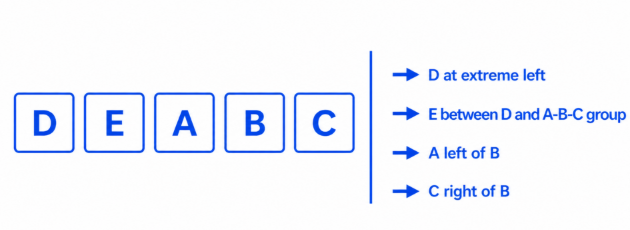
5 people A, B, C, D, E are sitting in a row.
Clue 1: A is to the left of B.
Clue 2: C is to the right of B.
Clue 3: D is at the extreme left.
Clue 4: E is between C and D.
Solution:
From Clue 3: D _ _ _ _
From Clue 4: E is between C and D.
From Clues 1 and 2: ...A B C...
Place D at left, E next, then A B C:
D E A B C
Answer: D E A B C
Type 2: Circular Arrangement (Facing the Center)
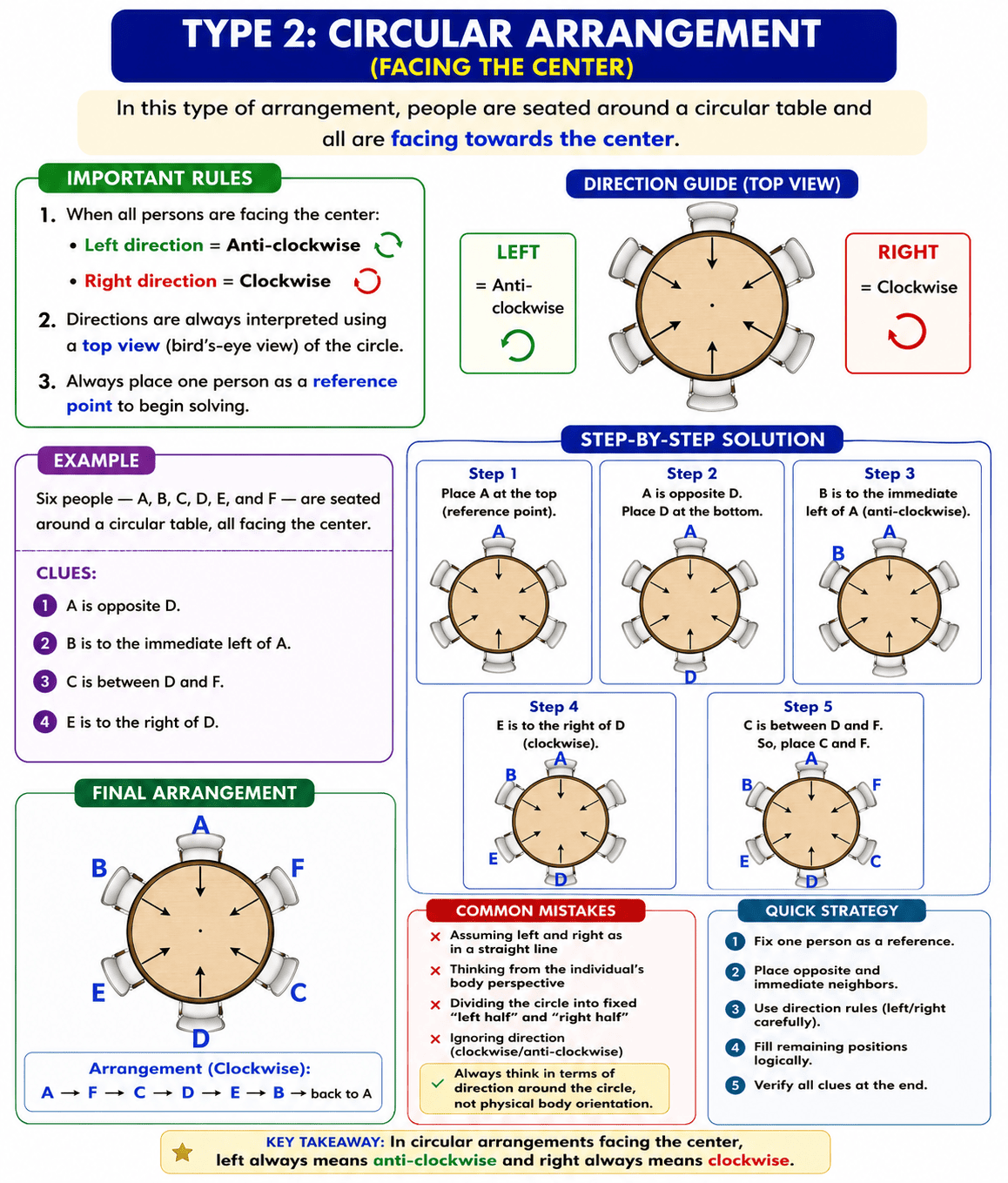
In this type of arrangement, people are seated around a circular table and all are facing towards the center. This changes the way we interpret left and right directions compared to linear arrangements.
Important Rules
- When all persons are facing the center:
- Left direction = Anti-clockwise
- Right direction = Clockwise
- Directions are always interpreted using a top view (bird’s-eye view) of the circle.
- Always place one person as a reference point to begin solving.
Common Mistakes to Avoid
- ❌ Assuming left and right as in a straight line
- ❌ Thinking from the individual’s body perspective
- ❌ Dividing the circle into fixed “left half” and “right half”
- ❌ Ignoring direction (clockwise/anti-clockwise)
✔ Always think in terms of direction around the circle, not physical body orientation.
Example
Six people — A, B, C, D, E, and F — are seated around a circular table, all facing the center.
Clues:
- A is opposite D.
- B is to the immediate left of A.
- C is between D and F.
- E is to the right of D.
Step-by-Step Solution:
Step 1: Fix a Reference Point
Place A at the top (for convenience).
Step 2: Place Opposite Person
A is opposite D → place D at the bottom.
Step 3: Apply Left Condition
B is to the immediate left of A.
Since all are facing the center:
- Left = anti-clockwise
So, place B at the position immediately anti-clockwise from A (top-left).
Step 4: Apply Right Condition
E is to the right of D.
- Right = clockwise
From D (bottom), move clockwise → place E at bottom-left.
Step 5: Use Remaining Clue
C is between D and F.
This means:
- D – C – F
or - F – C – D
Now fill the remaining positions logically.
Placing:
- C at bottom-right
- F at top-right
satisfies all conditions.
Final Arrangement (Clockwise)
A → F → C → D → E → B → back to A
Final Positions
- Top → A
- Top-right → F
- Bottom-right → C
- Bottom → D
- Bottom-left → E
- Top-left → B
Quick Strategy for Students
- Fix one person as a reference
- Place opposite and immediate neighbors
- Use direction rules (left/right carefully)
- Fill remaining positions logically
- Verify all clues at the end
Key Takeaway
In circular arrangements facing the center,
left always means anti-clockwise and right always means clockwise.
Type 3 - Double Row Arrangement Two rows of people face each other.
Concept: Two rows of people sit facing each other. One row faces North, the other faces South. Each person in one row faces exactly one person in the other row.
Where Most People Get Confused (Important points)
Many people think like this:
“If a person is looking toward North, then they must be North-facing.”
👉 This is incorrect and creates confusion in almost every double-row question.
Correct Definition (Very Important)
- North-facing = the person’s face is oriented toward the North direction
- South-facing = the person’s face is oriented toward the South direction
👉 It does NOT depend on whom they are looking at
What the Question Actually Means
When a question says:
- Row 1 faces North
- Row 2 faces South
It simply means:
- People in Row 1 are oriented toward North (↑)
- People in Row 2 are oriented toward South (↓)
Then Why Do They Face Each Other?
This is the biggest confusion.
👉 Do NOT think in real-life physical terms (like people sitting at a table)
Instead, follow this logical rule used in reasoning:
Opposite rows are always considered to be facing each other
So:
- If A is opposite Q → they are directly facing each other (by definition)
Key Clarification
- Facing direction is given in the question
- It is not something you decide by observing the diagram
Direction Rules (Must Remember)
- North-facing people
- Right = your right
- Left = your left
- South-facing people
- Right = your left
- Left = your right
Opposite Rule
- Opposite means:
- Same column
- Different row
Final Takeaway (No Confusion After This)
- Facing direction is fixed by the question
- It is NOT based on whom they are looking at
- Opposite rows are always treated as face-to-face
Example Question
Two rows of people are sitting facing each other:
- Row 1: A, B, C, D (facing North)
- Row 2: P, Q, R, S (facing South)
Clues:
- A is opposite Q
- B is to the immediate right of A
- C is to the immediate left of B
- D sits at one of the extreme ends
- P is opposite D
- R is to the immediate left of Q
- S is at one of the ends
Step-by-Step Solution:
Step 1: Arrange Row 1 (North-facing)
We have 4 positions:
_ _ _ _- From clue (2): B is to the immediate right of A → (A, B)
- From clue (3): C is to the immediate left of B → sequence becomes (A, C, B)
So now:
A C B _- From clue (4): D is at an extreme end → only last position is left
Final Row 1:
A C B D
Step 2: Map Opposite Positions
Each person in Row 1 faces someone in Row 2:
| Row 1 (North) | A | C | B | D |
|---|---|---|---|---|
| Row 2 (South) | ? | ? | ? | ? |
Step 3: Apply Opposite Clues
- From clue (1): A is opposite Q → Q is below A
- From clue (5): D is opposite P → P is below D
Now arrangement becomes:
| Row 1 | A | C | B | D |
|---|---|---|---|---|
| Row 2 | Q | ? | ? | P |
Step 4: Use Direction-Based Clue
- From clue (6): R is to the immediate left of Q
Important rule:
Since Row 2 faces South, directions are reversed.
- Left (for South-facing) = Right (for us)
So R will be placed to the right of Q:
Q R _ PStep 5: Place the Remaining Person
- Only S is left
- From clue (7): S is at one of the ends
Ends are already occupied (Q and P), so remaining position is:
Q R S P
Final Arrangement
Row 1 (North-facing):
A C B D
Row 2 (South-facing):
Q R S P
Key Rules to Remember
- North-facing: Right and Left remain normal
- South-facing: Right and Left are reversed
- Opposite means same column, different row
- Always solve one row first, then map the second row
How to Solve Sitting Arrangement Questions:
Step 1 - Read all clues once without solving.
Step 2 - Find the most definite clue (like extreme left/right or fixed position).
Step 3 - Start with that clue and place the person.
Step 4 - Use other clues one by one to fill remaining positions.
Step 5 - Verify all clues against final arrangement before answering.
Common Mistakes to Avoid:
Mistake 1 - In circular arrangement, confusing left and right. When facing center: your left = anti-clockwise direction.
Mistake 2 - Not verifying all clues at the end. Always check every clue against your final arrangement.
Mistake 3 - Assuming positions without reading all clues first. Read all clues before placing anyone.
Mistake 4 - In double row, forgetting that left-right perspective changes for opposite rows.
Quick Tricks:
Trick 1 - Always draw a diagram. Never try to solve sitting arrangement in your head.
Trick 2 - In linear arrangement, start with the person at extreme left or right.
Trick 3 - In circular arrangement, fix one person at top as reference and place others relative to them.
Trick 4 - Clues with words like "immediate left/right" or "adjacent to" are most specific - use them first.
Trick 5 - If stuck, use elimination - place possible positions and check which one satisfies all clues.
Important Tips:
- Always draw the arrangement on paper - this topic cannot be solved mentally
- In circular arrangement, mark the center and arrows showing who is facing where
- 3 to 5 questions come from this topic in SSC CGL every year
- In Banking exams (IBPS PO) this topic carries 15 to 20 marks alone
- Practice at least 2 complete arrangement sets daily