SSC CGL Tier 1
Non-Verbal Reasoning
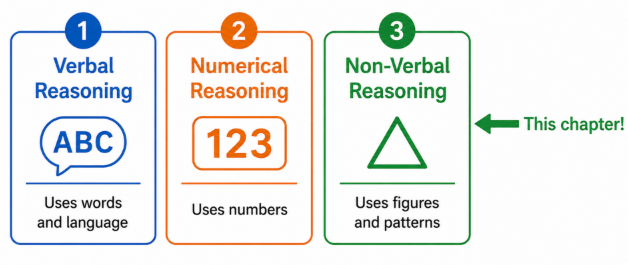
Non-Verbal Reasoning is a topic where questions are based entirely on figures, patterns and diagrams - not on words or numbers. You have to identify patterns, relationships and rules by looking at visual figures only. It is the last and most visual chapter of the Reasoning section.
What is Non-Verbal Reasoning?
Non-Verbal Reasoning tests your ability to:
- Identify patterns in a series of figures
- Find the odd figure out of a group
- Understand spatial relationships between figures
- Identify how figures change or transform
This is different from Verbal Reasoning (which uses words) and Numerical Reasoning (which uses numbers).
Types of Non-Verbal Reasoning Questions in SSC CGL:
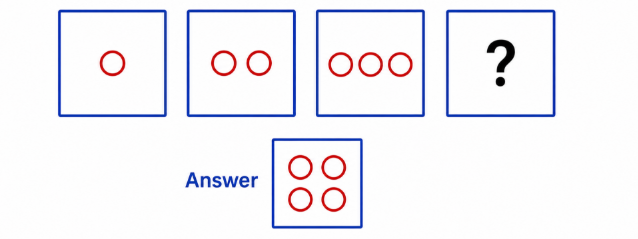
Type 1 - Figure Series A series of figures is given with a pattern and you have to find the next figure.
Example:
A square with 1 dot, then a square with 2 dots, then a square with 3 dots... what comes next? Answer: A square with 4 dots.
Rules to look for in figure series:
- Number of shapes increasing or decreasing
- Shape rotating clockwise or anti-clockwise
- Size of shape increasing or decreasing
- Pattern inside shape changing systematically
- Lines being added or removed
Type 2 - Figure Analogy Just like word analogy, two figures have a relationship and you have to apply the same relationship to find the missing figure.
Example:
Square : Rotated Square :: Triangle : ?
Answer: Rotated Triangle
Rules to look for:
- Same transformation applied (rotation, reflection, scaling)
- Same change in number of elements
- Same change in shading or pattern
Type 3 - Odd Figure Out Four or five figures are given and you have to find the one that is different from the rest.
Example: Four figures are given - three have the same number of sides and one has a different number. Find the odd one.
Rules to look for:
- Different number of sides
- Different orientation
- Different internal pattern
- Different size ratio
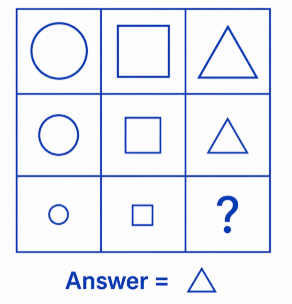
Type 4 - Figure Matrix A 3×3 or 2×2 grid of figures is given with one missing. You have to find the missing figure based on the row or column pattern.
Example:
Row 1: Circle, Square, Triangle
Row 2: Small Circle, Small Square, Small Triangle
Row 3: Dotted Circle, Dotted Square, ?
Answer: Dotted Triangle
Type 5 - Rules of Figure Transformation Figures transform from one step to the next. You have to identify the rule and apply it.
Common transformations:
- 90° clockwise rotation
- 90° anti-clockwise rotation
- 180° rotation
- Horizontal flip (mirror image)
- Vertical flip (water image)
- Addition of one element per step
- Removal of one element per step
- Alternating between two patterns
How to Solve Non-Verbal Reasoning Questions:
Step 1 - Look at each figure in the series carefully from left to right.
Step 2 - Identify what changes from one figure to the next.
Step 3 - Look for changes in: shape, size, number, orientation, shading, position.
Step 4 - Find the consistent rule that applies to ALL figures.
Step 5 - Apply the rule to find the missing or next figure.
Step 6 - Check your answer against all given figures to verify the rule holds.
Common Mistakes to Avoid:
Mistake 1 - Identifying the rule from only 2 figures. Always verify the rule against all given figures.
Mistake 2 - Overlooking subtle changes like shading or rotation direction. Look carefully at every element of each figure.
Mistake 3 - Confusing clockwise with anti-clockwise rotation. Draw a small arrow to mark direction before answering.
Mistake 4 - In figure analogy, applying the wrong transformation. Identify the exact transformation - rotation, flip or scale.
Quick Tricks:
Trick 1 - Always check the number of elements first - this is the most common pattern.
Trick 2 - For rotation questions, check if the rotation is 45°, 90° or 180°.
Trick 3 - In odd figure out, check symmetry - symmetric vs asymmetric figures.
Trick 4 - In figure matrix, check both row pattern and column pattern to confirm your answer.
Trick 5 - When two transformations seem possible - choose the simpler one.
Important Tips:
- This is entirely a visual topic - no formula required
- Practice improves speed dramatically for this topic
- 3 to 5 questions come from Non-Verbal Reasoning in SSC CGL every year
- Always check the rule against all given figures before finalizing
- Practice daily with 10 different non-verbal questions