Supreme Court Landmark Ruling - Right to Trauma Care Declared Integral Part of Right to Life Under Article 21; Pan-India Directions Issued to All States and UTs
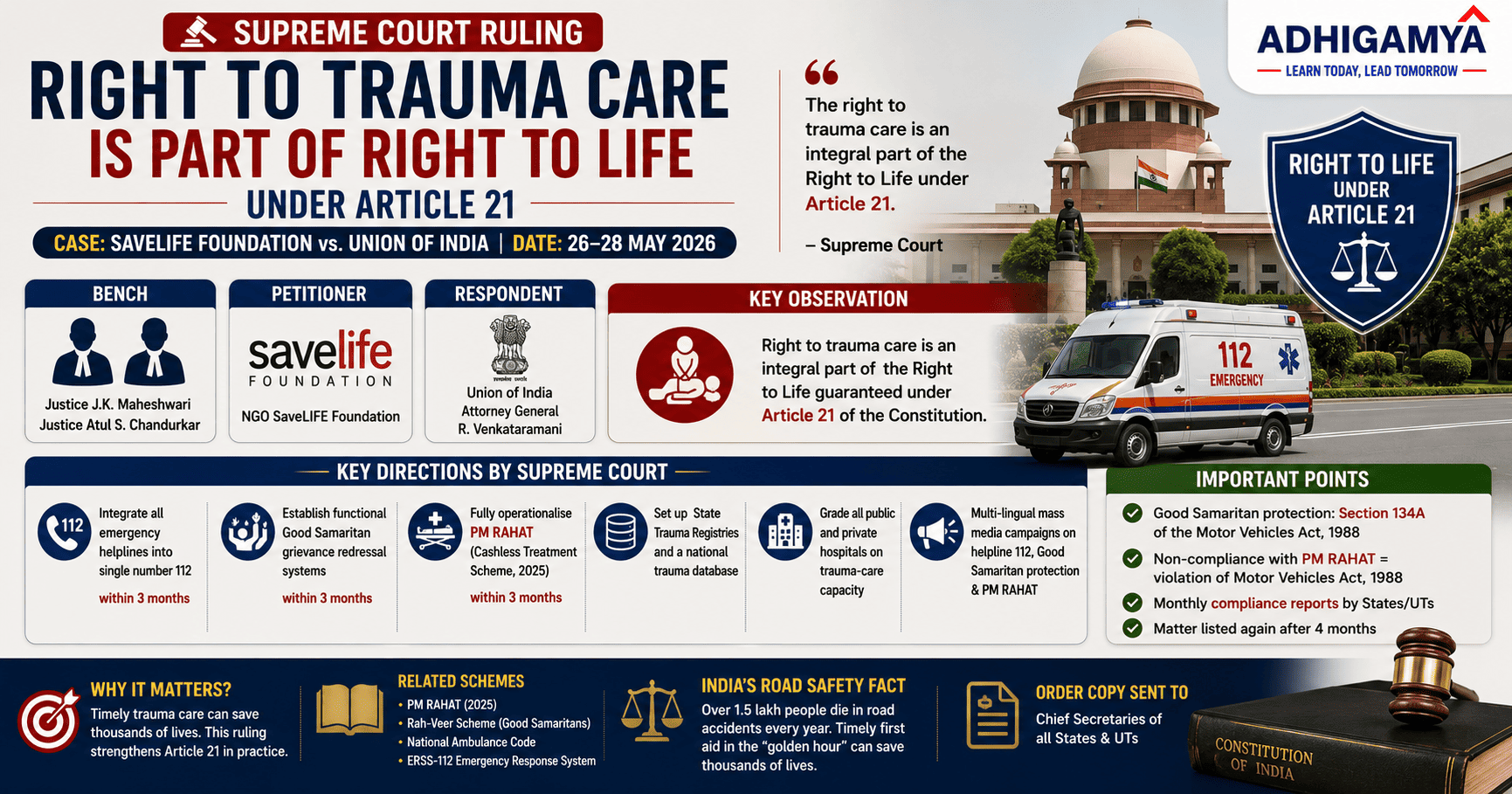
The Supreme Court on Tuesday held that the right to trauma care is an integral part of the right to life guaranteed under Article 21 of the Constitution in the case of Savelife Foundation vs. Union of India. A bench of Justices JK Maheshwari and Atul S Chandurkar made the observation while issuing a slew of directions to all States and Union Territories to build a uniform road accident trauma care system across the country.
The Supreme Court recognised the right to trauma care as an integral part of the Right to Life under Article 21 of the Constitution and directed all States and Union Territories to integrate multiple emergency helplines into the single national emergency number 112 within three months. The Bench passed the directions while hearing a petition filed by SaveLIFE Foundation, which highlighted the alarming number of deaths caused due to delayed emergency response and the absence of a uniform trauma-care framework across the country.
The Court passed the order on a petition filed by NGO SaveLife Foundation seeking directions to integrate all emergency helplines into a single universal access number, establish good samaritan grievance redressal systems, frame a standardised medical rescue protocol, ensure ambulance compliance with national codes, set up State trauma registries and operationalise cashless treatment schemes for road accident victims. Besides passing other interim directions, the bench directed the Centre, States and UTs to undertake sustained, structured, multi-lingual mass-media campaigns covering helpline 112, the Good Samaritan protection under Section 134A of the Motor Vehicles Act, the grievance redressal system, and the cashless treatment scheme PM RAHAT with defined obligations and compliance reporting within a month.
Background: India records one of the highest numbers of road accident fatalities in the world. According to Ministry of Road Transport and Highways data, India witnesses over 1.5 lakh road accident deaths every year. A large proportion of these deaths are preventable - studies show that timely first aid and prompt hospital access within the "golden hour" can save thousands of lives annually. However, India's emergency response system has remained fragmented, with multiple helpline numbers creating confusion, Good Samaritans fearing legal harassment, and trauma-care infrastructure varying widely across states.
SaveLIFE Foundation, an NGO focused on road safety, filed a Public Interest Litigation (PIL) in the Supreme Court seeking systemic reform. In compliance with a Supreme Court judgement, UPSC had earlier formulated guidelines related to transparency in public examinations. Similarly here, the Union government had already launched PM RAHAT (the Cashless Treatment of Road Accident Victims Scheme, 2025), the Rah-Veer Scheme for Good Samaritans, the National Ambulance Code, and the ERSS-112 emergency response system. However, ground-level implementation had remained incomplete across several States and UTs.
Why in News: This Supreme Court ruling is one of the most important judicial developments of 2026 for competitive exams. It directly links the Right to Life (Article 21) to trauma care - expanding the constitutional interpretation. For UPSC, SSC CGL, Banking, and Railway exams, questions may be asked on the case name (Savelife Foundation vs. Union of India), the judges on the bench, Article 21, helpline 112, PM RAHAT scheme, Good Samaritan law (Section 134A of the Motor Vehicles Act), and the timeline given to States to comply. It also tests knowledge of India's road safety landscape and fundamental rights jurisprudence.
Key Points to Remember:
- Supreme Court ruling date: 26-28 May 2026
- Case name: Savelife Foundation vs. Union of India
- Bench: Justice J.K. Maheshwari and Justice Atul S. Chandurkar
- Petitioner: SaveLIFE Foundation (NGO)
- Respondent: Union of India; Attorney General R. Venkataramani appeared for UoI
- Key ruling: Right to trauma care is an integral part of Right to Life under Article 21 of the Constitution
- Key direction 1: All States and UTs to integrate all emergency helplines into single number 112 within 3 months
- Key direction 2: Establish functional Good Samaritan grievance redressal systems within 3 months
- Key direction 3: Fully operationalise PM RAHAT (Cashless Treatment of Road Accident Victims Scheme, 2025) within 3 months
- Key direction 4: Set up State Trauma Registries and a national trauma database
- Key direction 5: Grade all public and private hospitals on trauma-care capacity
- Key direction 6: Multi-lingual mass media campaigns on helpline 112, Good Samaritan protection, and PM RAHAT
- Non-compliance with PM RAHAT directions = violation of Motor Vehicles Act, 1988
- States to submit monthly compliance reports; matter listed again after 4 months
- Good Samaritan protection: Section 134A of the Motor Vehicles Act
- Order copy sent to Chief Secretaries of all States and UTs
Related Static GK:
- Article 21 of the Indian Constitution: "No person shall be deprived of his life or personal liberty except according to procedure established by law"
- Article 21 is part of Part III (Fundamental Rights) of the Constitution
- Landmark expansions of Article 21: Right to Education (Art 21A), Right to Health, Right to Privacy (K.S. Puttaswamy vs UoI, 2017), Right to Livelihood (Olga Tellis case, 1985)
- Supreme Court of India established: 28 January 1950; HQ: New Delhi
- Chief Justice of India (2026): Justice Surya Kant (took charge 24 November 2025)
- SaveLIFE Foundation: NGO focused on road safety; has earlier won landmark Supreme Court Good Samaritan guidelines in 2016
- PM RAHAT: Pradhan Mantri Road Accident Helpline and Treatment scheme; Cashless treatment for road accident victims
- Section 134A of Motor Vehicles Act: Protection to Good Samaritans from legal and procedural harassment
- Helpline 112: India's universal emergency response number (similar to 911 in USA, 999 in UK)
- India road accident deaths: Over 1.5 lakh per year (among highest in world)
- Motor Vehicles Act: 1988 (amended significantly in 2019 to strengthen road safety provisions)
- PIL (Public Interest Litigation): A legal mechanism in India allowing any citizen to approach the Supreme Court or High Court in the interest of the general public