Nation Observes 62nd Death Anniversary of Jawaharlal Nehru - First Prime Minister and Architect of Modern India Remembered Across the Country
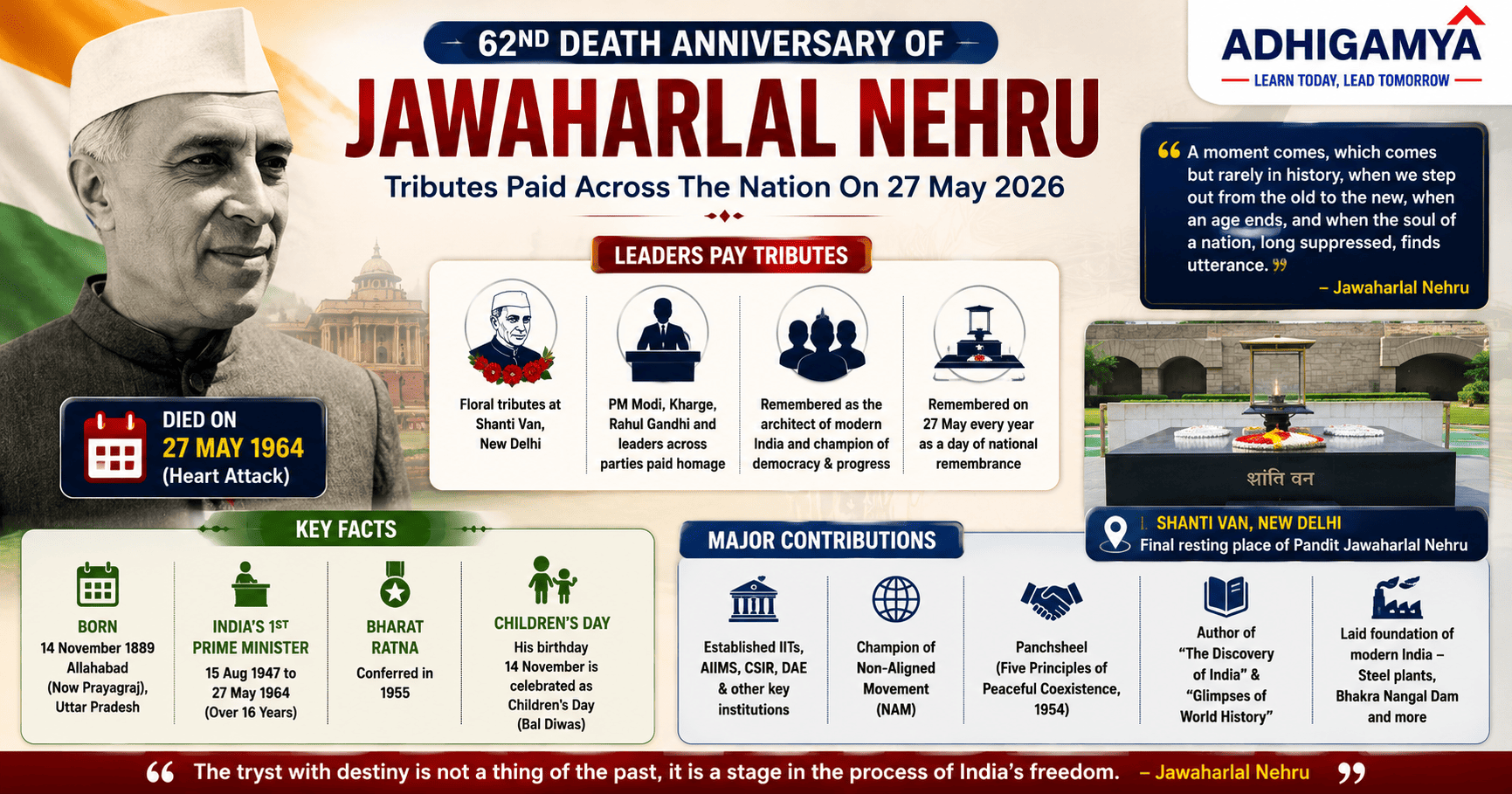
Leaders across the political spectrum on Wednesday paid tribute to India's first prime minister Jawaharlal Nehru on his death anniversary, remembering his contribution to nation-building, democracy and India's freedom struggle. Prime Minister Narendra Modi paid homage to former Prime Minister Pandit Jawaharlal Nehru on his death anniversary on May 27, 2026. Congress president Mallikarjun Kharge and Leader of Opposition in Lok Sabha Rahul Gandhi paid floral tributes to Nehru at his memorial at Shanti Van in the national capital. Senior Congress leaders KC Venugopal and BK Hariprasad were also present.
Mallikarjun Kharge led the tributes from the Congress, describing Nehru as "the architect of modern India" and a leader who shaped the country's democratic and scientific outlook. NCP (SP) MP Supriya Sule also paid tribute to Nehru, saying he laid the foundation for the nation's progress. In Karnataka, Chief Minister Siddaramaiah participated in commemorative events in Bengaluru marking Nehru's death anniversary, including a remembrance programme at the Karnataka Pradesh Congress Committee office and another tribute event in front of the Vidhana Soudha.
Jawaharlal Nehru, a central figure in India's freedom movement, became the country's first Prime Minister after Independence in 1947 and remained in office for over 16 years. He died of a heart attack on May 27, 1964. The 62nd death anniversary is observed every year on May 27 as a day of national remembrance.
Background: Jawaharlal Nehru was born on November 14, 1889, in Allahabad (now Prayagraj), Uttar Pradesh. He was a prominent leader of the Indian National Congress and a key figure in the independence movement under the guidance of Mahatma Gandhi. Nehru served as India's first Prime Minister from August 15, 1947, until his death on May 27, 1964 - making him the longest-serving Prime Minister of India with a tenure of over 16 years. He was conferred the Bharat Ratna in 1955. His birthday, November 14, is celebrated as Children's Day (Bal Diwas) across India in his memory, reflecting his deep love for children.
Nehru is credited with laying the foundation of modern India's institutions - he established the Indian Institutes of Technology (IITs), the All India Institute of Medical Sciences (AIIMS), and supported the establishment of ISRO's predecessor organisations. He championed India's Non-Aligned Movement (NAM) foreign policy during the Cold War, keeping India independent of both the American and Soviet blocs. He was also the author of celebrated works such as "The Discovery of India" and "Glimpses of World History."
Why in News: Jawaharlal Nehru's 62nd death anniversary is observed on May 27 every year and generates tributes from across the political spectrum. For competitive exam purposes, questions are regularly asked on Nehru's term as PM, the date and cause of his death, his major contributions such as IITs, AIIMS, NAM, Panchsheel, and his books. His birthday as Children's Day, his Bharat Ratna, and the location of his memorial Shanti Van are all standard exam facts. This anniversary serves as an important occasion to revisit India's foundational history.
Key Points to Remember:
- Jawaharlal Nehru's 62nd death anniversary observed on 27 May 2026
- PM Modi, Congress President Kharge, LoP Rahul Gandhi and leaders across parties paid tributes
- Floral tributes paid at Shanti Van, New Delhi - Nehru's memorial
- Nehru's birth date: 14 November 1889, Allahabad (now Prayagraj), Uttar Pradesh
- Nehru's death: 27 May 1964, New Delhi (heart attack)
- Position: India's 1st Prime Minister; also 1st Deputy Prime Minister was Sardar Vallabhbhai Patel
- Tenure as PM: 15 August 1947 to 27 May 1964 (over 16 years - longest-serving Indian PM)
- Nehru was conferred Bharat Ratna in 1955
- His birthday November 14 is celebrated as Children's Day (Bal Diwas) in India
- Major institutional contributions: IITs, AIIMS, Planning Commission, CSIR, DAE, NAM
- Foreign policy: Champion of Non-Aligned Movement (NAM) and Panchsheel (Five Principles of Peaceful Coexistence, 1954)
- Major books: "The Discovery of India", "Glimpses of World History", "An Autobiography"
- Memorial at: Shanti Van, Rajghat complex, New Delhi
- Nehru is also remembered as the father of India's scientific and industrial vision (Steel plants, Bhakra Nangal Dam etc.)
Related Static GK:
- Shanti Van: Nehru's memorial; located on the banks of river Yamuna, New Delhi; Rajghat (Gandhi's memorial) is nearby
- Children's Day India: 14 November (Nehru's birthday); celebrated since 1964 after his death
- Before 1964, Children's Day was celebrated on November 20 (UN World Children's Day)
- Panchsheel Agreement: 1954, signed between India and China; Five Principles: mutual respect for sovereignty, mutual non-aggression, mutual non-interference, equality and mutual benefit, peaceful coexistence
- Non-Aligned Movement (NAM): founded 1961 at Belgrade Summit; India was a founding member; other founders include Yugoslavia (Tito), Egypt (Nasser), Indonesia (Sukarno), Ghana (Nkrumah)
- Bharat Ratna: India's highest civilian award; Nehru received it in 1955
- Nehru's daughter: Indira Gandhi (India's first woman PM; PM 1966-77 and 1980-84)
- Nehru's grandson: Rajiv Gandhi (PM 1984-89)
- IIT system: First IIT established at Kharagpur, West Bengal in 1951 during Nehru's tenure
- AIIMS New Delhi: Established 1956 under the AIIMS Act during Nehru's tenure
- Planning Commission: Established 1950 (replaced by NITI Aayog in 2015)
- PM Modi took oath as PM on 26 May 2014; completed 12 years in office on 26 May 2026