RBI Constitutes 8-Member Expert Committee Q-SAFE to Prepare India's Financial System Against Quantum Technology Risks
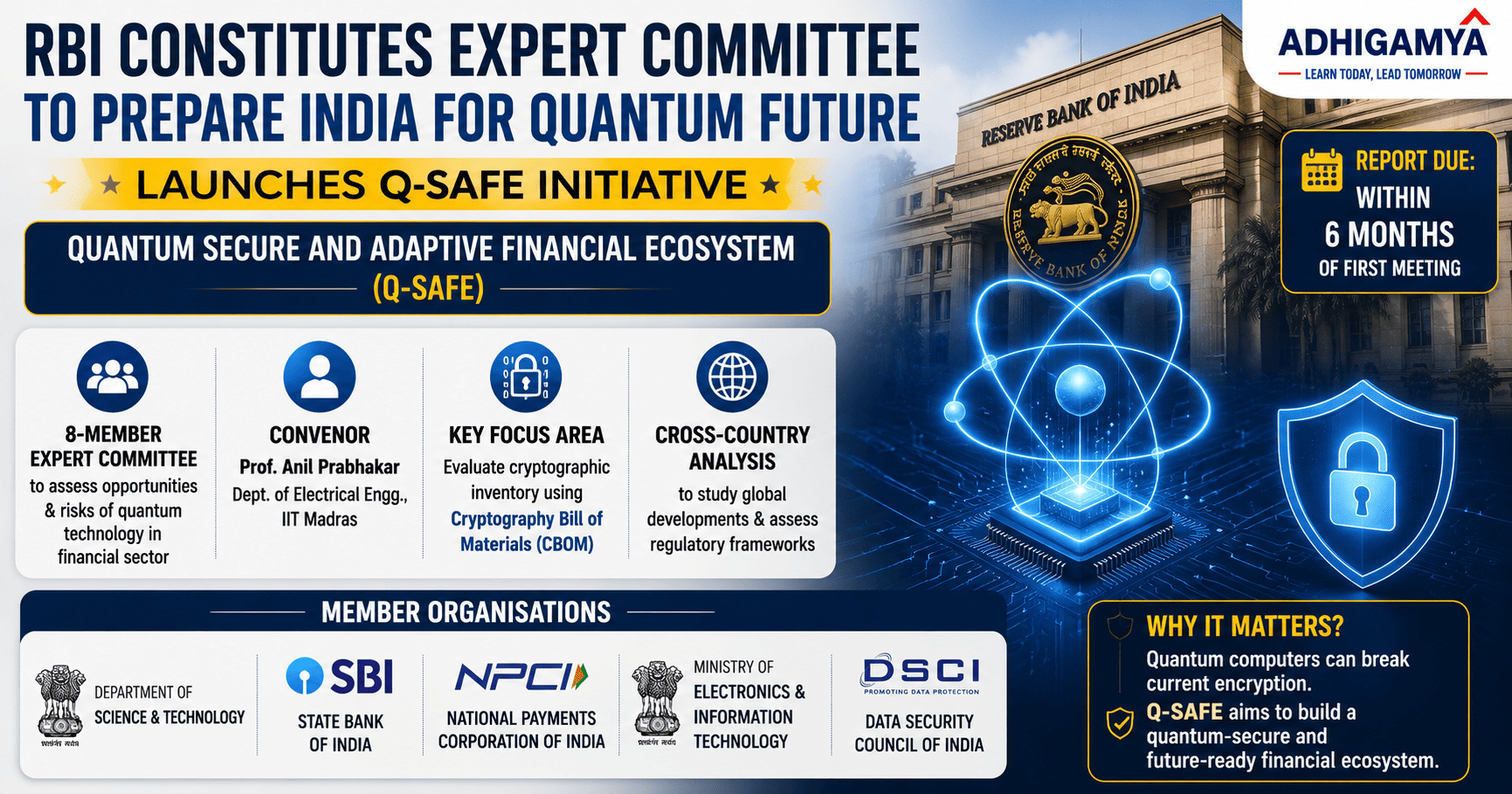
The Reserve Bank of India constituted an expert committee to examine the opportunities and risks arising from quantum technology in the financial sector and to prepare a roadmap for making India's financial ecosystem secure against future quantum-related cyber threats. The committee has been formed under the initiative called Quantum Secure and Adaptive Financial Ecosystem (Q-SAFE).
The Reserve Bank of India formed an eight-member panel to study issues related to quantum technology and recommend a roadmap and framework to quantum-secure the Indian financial system. Anil Prabhakar, Professor in the Department of Electrical Engineering at the Indian Institute of Technology Madras, will be the Convenor of the panel, and the FinTech Department of the RBI will provide secretarial support to the committee. Other members include officials from the Department of Science and Technology, State Bank of India, National Payments Corporation of India, the Ministry of Electronics and Information Technology, and the Data Security Council of India.
The committee has been asked to evaluate the financial sector's cryptographic inventory through a Cryptography Bill of Materials (CBOM) and assess crypto agility. The panel will undertake a cross-country analysis to study global developments and assess whether existing regulatory frameworks are sufficient for the safe deployment of quantum applications in the financial sector. The committee is expected to submit its report within six months from the date of its first meeting.
Background: Quantum technology is a field based on the principles of quantum mechanics - the science that describes the behaviour of matter and energy at the atomic and subatomic levels. Unlike classical computers that use bits (0 or 1), quantum computers use qubits that can exist in multiple states simultaneously (superposition) and can be linked together (entanglement), enabling them to solve enormously complex calculations at speeds unimaginable with conventional systems. RBI noted that quantum systems can address complex financial problems such as portfolio optimisation, risk assessment, and macroeconomic modelling. However, quantum technologies can also introduce significant risks, particularly the potential to undermine certain existing cryptographic standards.
The major concern for the financial sector is "Harvest Now, Decrypt Later" - a strategy where adversaries collect encrypted data today with the intention of decrypting it once sufficiently powerful quantum computers become available. India's financial system - including UPI transactions, banking data, and government financial records - relies heavily on encryption standards that quantum computers could potentially break. The Q-SAFE initiative is India's formal response to this emerging threat.
Why in News: The RBI's Q-SAFE committee is highly exam-relevant because it represents India's first formal institutional step toward quantum-proofing its financial sector. For Banking and UPSC exams, questions may be asked on the committee name (Q-SAFE), its full form, the convenor (Prof. Anil Prabhakar, IIT Madras), member organisations, the term Cryptography Bill of Materials (CBOM), and the report submission timeline. The story also links to broader topics of cyber security, digital finance, and India's technology policy - all important for SSC CGL and Railway exams as well.
Key Points to Remember:
- RBI constituted Q-SAFE expert committee on 25 May 2026
- Q-SAFE full form: Quantum Secure and Adaptive Financial Ecosystem
- Committee size: 8 members
- Convenor: Prof. Anil Prabhakar, Department of Electrical Engineering, IIT Madras
- Secretariat support: FinTech Department of RBI
- Member organisations include: Department of Science and Technology, State Bank of India (SBI), National Payments Corporation of India (NPCI), Ministry of Electronics and Information Technology (MeitY), Data Security Council of India (DSCI)
- Key task: Evaluate the financial sector's cryptographic inventory through a Cryptography Bill of Materials (CBOM)
- Committee to assess crypto agility and recommend a quantum-secure roadmap for India's financial system
- Panel will conduct cross-country analysis of global quantum regulatory frameworks
- Report to be submitted within 6 months of first meeting
- Two core aspects of quantum technology relevant here: Superposition and Entanglement
- Initiative is India's formal response to "Harvest Now, Decrypt Later" quantum cyber threat
Related Static GK:
- RBI full form: Reserve Bank of India; established April 1, 1935; HQ: Mumbai
- RBI Governor (2026): Sanjay Malhotra
- IIT Madras: established 1959; located in Chennai, Tamil Nadu; an Institute of National Importance
- NPCI full form: National Payments Corporation of India; established 2008; HQ: Mumbai; operates UPI, RuPay, IMPS, NEFT, RTGS
- MeitY full form: Ministry of Electronics and Information Technology
- DSCI full form: Data Security Council of India; set up by NASSCOM
- NASSCOM full form: National Association of Software and Service Companies
- SBI full form: State Bank of India; HQ: Mumbai; largest public sector bank in India
- Quantum computing world leaders: USA (IBM, Google), China; India's National Quantum Mission (NQM) launched in 2023 with Rs 6,003 crore outlay over 2023-2031
- India's National Quantum Mission (NQM) overseen by Department of Science and Technology (DST)
- UPI full form: Unified Payments Interface; developed by NPCI; launched 2016
- Cryptography: science of securing information through encoding; widely used in banking, defence, and digital communications