India-UK Critical Minerals Global Supply Chain Observatory (GSCO) Launched in New Delhi - Joint Platform by IIT (ISM) Dhanbad and University of Cambridge
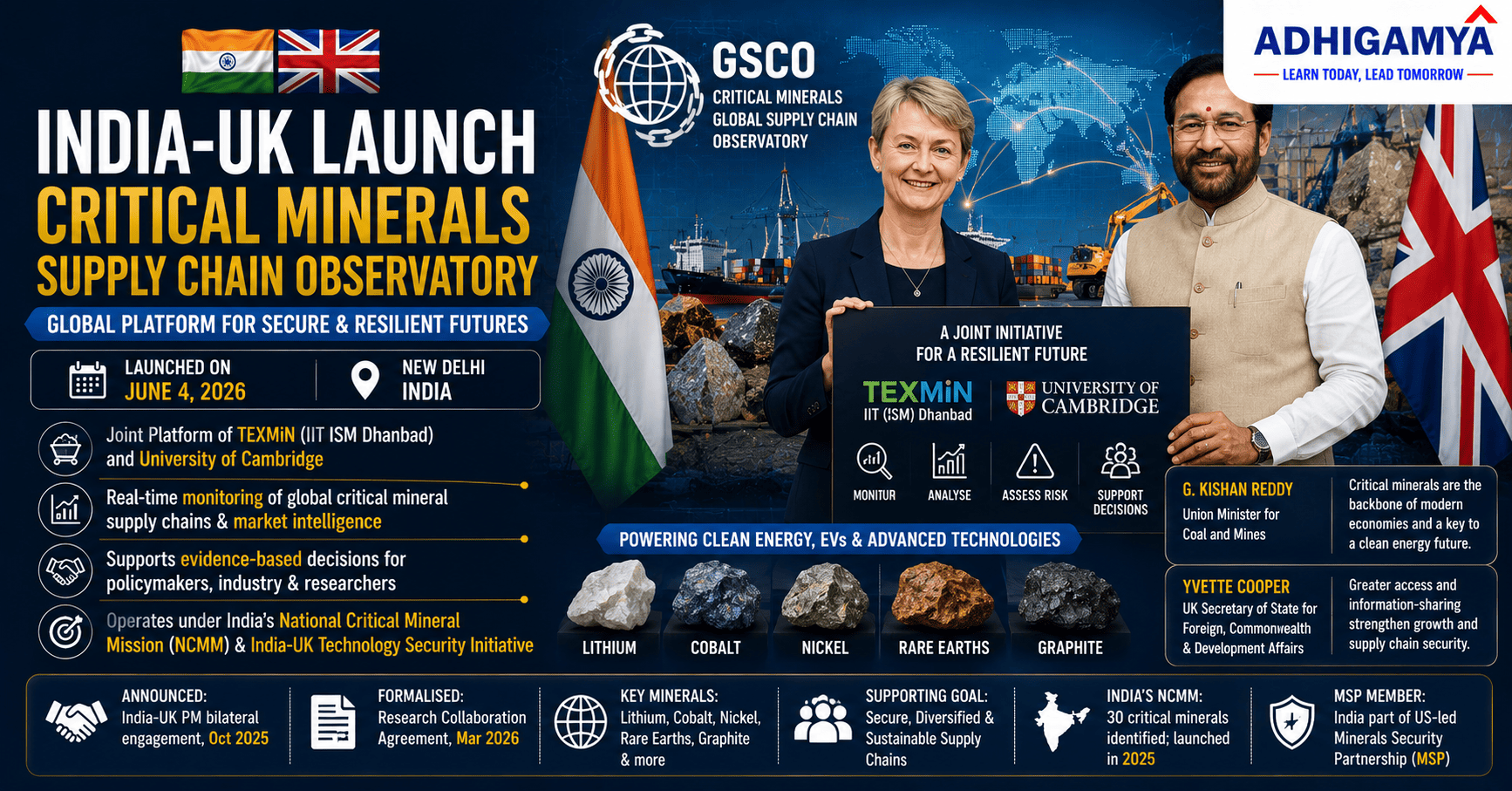
The India-UK Critical Minerals Global Supply Chain Observatory (GSCO) was formally launched in New Delhi on June 4, 2026, by Union Minister for Coal and Mines G. Kishan Reddy and UK Secretary of State for Foreign, Commonwealth and Development Affairs Yvette Cooper. The Observatory is a joint platform developed by TEXMiN at the Indian Institute of Technology (ISM) Dhanbad and the University of Cambridge, designed to monitor and analyse global critical mineral supply chains in real time.
The platform will track global critical mineral supply chains, identify supply risks and disruptions, generate market intelligence, and support evidence-based decision-making by policymakers, industry, and researchers. Minister Kishan Reddy described critical minerals as the backbone of modern economies, indispensable for clean energy technologies, electric mobility, advanced manufacturing, and emerging technology sectors. UK Foreign Secretary Yvette Cooper stated that greater access to critical minerals and improved information-sharing are in the mutual interest of both nations and can significantly strengthen economic growth and supply-chain security.
The initiative was first announced during the India-UK Prime Ministers' bilateral engagement in October 2025 and was subsequently formalised through a Research Collaboration Agreement signed in March 2026. The Observatory operates under the goals of India's National Critical Mineral Mission (NCMM) and the India-UK Technology Security Initiative. An interactive demonstration of the platform was jointly presented by TEXMiN and the University of Cambridge at the launch event.
Background: Critical minerals such as lithium, cobalt, nickel, rare earth elements, graphite, and manganese are essential for clean energy technologies including batteries for EVs, solar panels, wind turbines, and defence and aerospace applications. Global supply chains for these minerals are currently dominated by China, which controls a large share of both mining and processing. This concentration poses a strategic vulnerability for countries like India and the UK that are racing to decarbonise their economies. India launched its National Critical Mineral Mission (NCMM) in 2025 to secure domestic and overseas supply of 30 identified critical minerals. India is also a member of the Minerals Security Partnership (MSP) - a US-led coalition of like-minded nations working to diversify critical mineral supply chains away from single-source dependence.
Why in News: This is a significant bilateral science and technology and economic diplomacy story. For UPSC, SSC CGL, Banking, and Railway exams, questions can be asked on the GSCO full form, launch date, participating institutions (TEXMiN/IIT ISM Dhanbad and University of Cambridge), who launched it (G. Kishan Reddy, Yvette Cooper), the National Critical Mineral Mission, the India-UK Technology Security Initiative, and the context of China's dominance in critical minerals supply chains.
Key Points to Remember:
- GSCO launched: June 4, 2026, New Delhi
- GSCO full form: Critical Minerals Global Supply Chain Observatory
- Launched by: G. Kishan Reddy (Union Minister for Coal and Mines) + Yvette Cooper (UK Secretary of State for FCDO)
- Joint platform of: TEXMiN (IIT ISM Dhanbad) + University of Cambridge
- TEXMiN full form: Technology Innovation in Exploration and Mining Foundation
- TEXMiN type: Technology Translational Research Park (TTRP) under DST at IIT (ISM) Dhanbad
- IIT (ISM) Dhanbad Director: Sukumar Mishra (also Chairman, Governing Board of TEXMiN)
- Purpose: Data-driven platform to monitor global critical mineral supply chains, flag disruptions, generate market intelligence
- Initiative announced: India-UK PM bilateral engagement, October 2025
- Formalised via: Research Collaboration Agreement, March 2026
- Operates under: India's National Critical Mineral Mission (NCMM) + India-UK Technology Security Initiative
- Key minerals covered: Lithium, cobalt, nickel, rare earth elements, graphite, manganese etc.
- Sector relevance: Clean energy, EV batteries, advanced manufacturing, defence, aerospace
- India's NCMM: National Critical Mineral Mission; 30 identified critical minerals; launched 2025
Related Static GK:
- GSCO: First bilateral critical minerals intelligence observatory of its kind between India and UK
- TEXMiN: under Department of Science and Technology (DST); Ministry of Science and Technology
- IIT (ISM) Dhanbad: Located in Dhanbad, Jharkhand; one of India's oldest engineering institutions (est. 1926 as Indian School of Mines); became IIT in 2016
- University of Cambridge: Established 1209; located in Cambridge, UK; one of the world's oldest and most prestigious universities
- National Critical Mineral Mission (NCMM): Launched 2025 by India; identifies 30 critical minerals; goal to ensure secure domestic and overseas supply
- Minerals Security Partnership (MSP): US-led coalition for critical mineral supply chain diversification; India is a member; launched 2022
- India-UK Technology Security Initiative: Framework for bilateral cooperation on strategic and emerging technologies
- UK FCDO full form: Foreign, Commonwealth and Development Affairs
- China's dominance in critical minerals: Controls 60%+ of global rare earth processing; 70%+ of cobalt refining; major concern for India, US, EU, UK
- Critical minerals importance: Essential for EV batteries (lithium, cobalt, nickel), solar panels (silicon, silver), wind turbines (rare earths), semiconductors (germanium, gallium)
- India's Coal and Mines Minister (2026): G. Kishan Reddy (also holds Ministry of Coal portfolio)