Union Cabinet Approves Rs 9,585 Crore Delhi-NCR Vehicle Replacement Scheme to Replace Old Trucks and Buses with BS-VI and Electric Vehicles
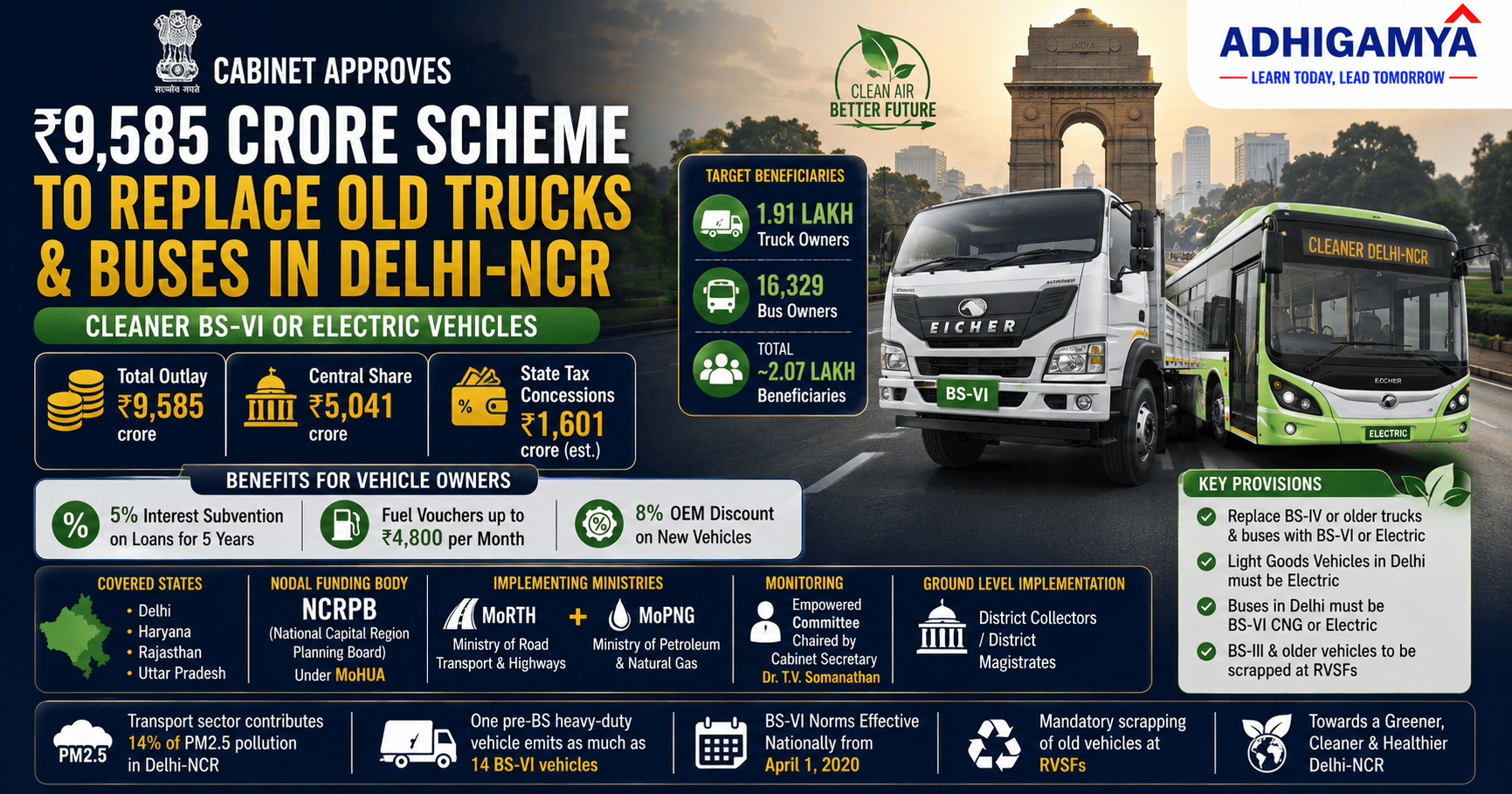
The Union Cabinet, chaired by Prime Minister Narendra Modi, approved a two-year scheme worth Rs 9,585 crore on June 3, 2026, to replace old trucks and buses in the Delhi-NCR region with cleaner BS-VI-compliant or electric vehicles. The scheme targets owners of commercial vehicles registered in Delhi-NCR that conform to BS-IV or earlier emission norms - approximately 1.91 lakh truck owners and 16,329 bus owners across Delhi, Haryana, Rajasthan, and Uttar Pradesh, totalling about 2.07 lakh beneficiaries.
The scheme will be funded through the National Capital Region Planning Board (NCRPB) under the Ministry of Housing and Urban Affairs (MoHUA) and implemented jointly by the Ministry of Road Transport and Highways (MoRTH) and the Ministry of Petroleum and Natural Gas (MoPNG). The central government will contribute Rs 5,041 crore, with participating states providing an estimated Rs 1,601 crore through tax concessions. Benefits to vehicle owners include 5 per cent interest subvention on loans for five years, monthly fuel vouchers of up to Rs 4,800, and OEM discounts of 8 per cent on new vehicles. In Delhi specifically, light goods vehicles must be replaced with electric variants, and buses must be BS-VI CNG or electric only.
An Empowered Committee chaired by Cabinet Secretary Dr. T.V. Somanathan will oversee implementation, with District Collectors and District Magistrates as ground-level implementing authorities.
Background: Delhi-NCR is one of the most polluted regions in the world, consistently ranking among the top cities globally for PM2.5 and AQI levels. The transport sector contributes approximately 14 per cent of PM2.5 pollution in Delhi-NCR. Pre-BS-IV heavy-duty vehicles are a major source, as a single older vehicle emits as much as 14 BS-VI-compliant vehicles. India introduced BS-VI (Bharat Stage VI) emission norms nationally from April 1, 2020, making it the world's most stringent jump in emission standards - leapfrogging directly from BS-IV to BS-VI. Despite this, a large number of older commercial vehicles continue to operate in the region, undermining air quality gains. Earlier measures such as the Odd-Even scheme, GRAP (Graded Response Action Plan), and the Vehicle Scrappage Policy (2021) had addressed parts of this problem but left the commercial vehicle segment inadequately covered.
Why in News: This Cabinet-approved scheme directly addresses Delhi-NCR's chronic air pollution crisis with a major financial outlay and multi-ministry coordination. For SSC CGL, Banking, UPSC, and Railway exams, questions can be asked on the scheme name, total outlay (Rs 9,585 crore), central government share (Rs 5,041 crore), beneficiaries (2.07 lakh), nodal body (NCRPB under MoHUA), key ministries (MoRTH, MoPNG), BS norms background, Cabinet Secretary's name (T.V. Somanathan), and the pollution contribution of the transport sector (14% PM2.5 in Delhi-NCR).
Key Points to Remember:
- Scheme approved by: Union Cabinet, chaired by PM Narendra Modi
- Date of approval: June 3, 2026
- Scheme duration: 2 years
- Total financial outlay: Rs 9,585 crore
- Central Government share: Rs 5,041 crore
- State tax concession share: Rs 1,601 crore (estimated)
- Target: Replace BS-IV or older trucks and buses with BS-VI or electric vehicles
- Total beneficiaries: approximately 2.07 lakh (1.91 lakh truck owners + 16,329 bus owners)
- States covered: Delhi, Haryana, Rajasthan, Uttar Pradesh
- Nodal funding body: NCRPB (National Capital Region Planning Board) under MoHUA
- Implementing ministries: MoRTH + MoPNG
- Monitoring: Empowered Committee chaired by Cabinet Secretary Dr. T.V. Somanathan
- Ground-level authorities: District Collectors/DMs
- Benefits: 5% interest subvention (5 years) + fuel vouchers up to Rs 4,800/month + 8% OEM discount
- Delhi-specific rule: Light goods vehicles must be electric; buses must be BS-VI CNG or electric
- BS-III and older vehicles: Mandatory scrapping at Registered Vehicle Scrapping Facilities (RVSFs)
- Transport sector contributes: 14% of PM2.5 pollution in Delhi-NCR
- A single pre-BS heavy-duty vehicle = emissions of 14 BS-VI vehicles
- BS-VI norms effective nationally: April 1, 2020 (India leapfrogged from BS-IV to BS-VI directly)
Related Static GK:
- NCRPB full form: National Capital Region Planning Board
- NCRPB under: Ministry of Housing and Urban Affairs (MoHUA)
- MoRTH full form: Ministry of Road Transport and Highways
- MoPNG full form: Ministry of Petroleum and Natural Gas
- BS-VI norms: Bharat Stage VI emission standards; adopted nationally April 1, 2020; equivalent to Euro 6 standards; India leapfrogged from BS-IV to BS-VI (skipped BS-V)
- BS norms (Bharat Stage): Indian emission standards based on European emission standards; introduced progressively to reduce vehicular pollution
- Vehicle Scrappage Policy (Voluntary Vehicle Fleet Modernisation Programme): Launched 2021; provides incentives for scrapping old vehicles at Registered Vehicle Scrapping Facilities (RVSFs)
- GRAP full form: Graded Response Action Plan; Delhi-NCR pollution control framework by CAQM
- CAQM full form: Commission for Air Quality Management in National Capital Region and Adjoining Areas; constituted 2021 by Act of Parliament
- PM2.5: Particulate matter with diameter less than 2.5 microns; most harmful air pollutant for human health
- Cabinet Secretary of India (2026): Dr. T.V. Somanathan (also serves as Finance Secretary)
- Delhi NCR states: Delhi + Haryana + Rajasthan + Uttar Pradesh + parts of Uttarakhand and Himachal Pradesh