Nepal Foreign Minister Shisir Khanal Concludes 3-Day India Visit - Holds Bilateral Talks with EAM Jaishankar; UPI-NPI Cross-Border Payment Linkage Launched
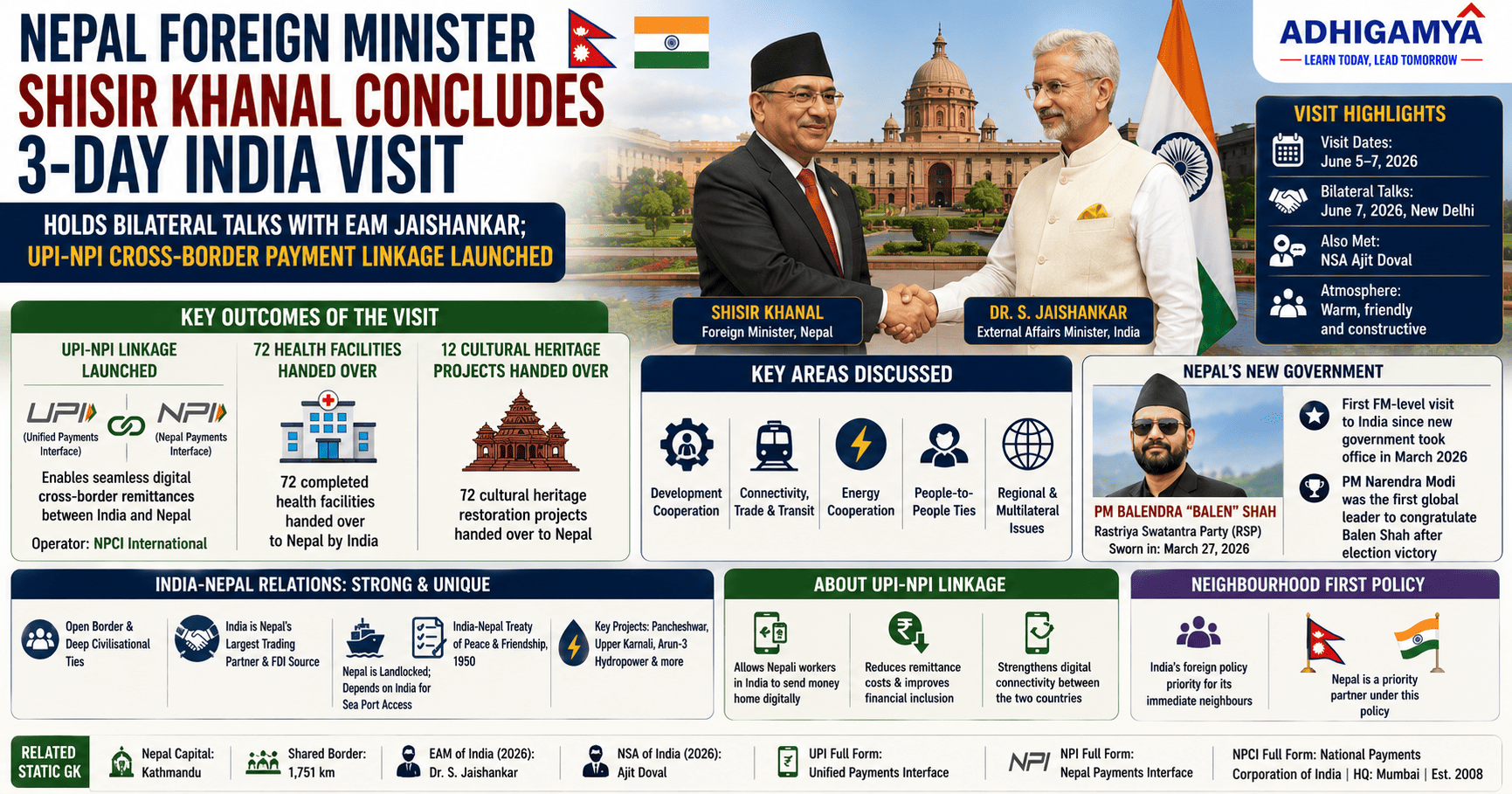
Nepal's Minister for Foreign Affairs Shisir Khanal concluded his three-day official visit to India on June 7, 2026, following bilateral talks with External Affairs Minister Dr. S. Jaishankar in New Delhi. The two ministers reviewed the full spectrum of India-Nepal bilateral relations covering development cooperation, connectivity, trade and transit, energy cooperation, and people-to-people ties. Foreign Minister Khanal also met National Security Advisor Ajit Doval separately during the visit.
The most significant outcome of the visit was the launch of the UPI-NPI (Unified Payments Interface - Nepal Payments Interface) linkage for cross-border remittances, enabling seamless digital payments between India and Nepal. Additionally, India handed over 72 completed health facilities and 12 cultural heritage restoration projects to Nepal, reflecting India's development assistance programme in the country. The two sides also exchanged views on regional and multilateral issues of mutual interest. Discussions were held in a warm, friendly, and constructive atmosphere, reflecting the unique and special ties between the two countries.
This was the first Foreign Minister-level visit from Nepal since Nepal's new government assumed office in March 2026 following a landslide victory by the Rastriya Swatantra Party (RSP) led by Prime Minister Balendra "Balen" Shah. PM Modi was the first global leader to congratulate Balen Shah after his election victory. The visit, made at the invitation of EAM Jaishankar, reinforced India's Neighbourhood First policy with Nepal as a priority partner.
Background: India and Nepal share a unique relationship - an open border, deep cultural and civilisational ties, and extensive economic interdependence. India is Nepal's largest trading partner and the biggest source of Foreign Direct Investment. Nepal is landlocked and depends on India for access to sea ports for third-country trade. Key bilateral pillars include the India-Nepal Treaty of Peace and Friendship (1950), which provides for free movement of people across the border, and several hydropower development projects through which India imports power from Nepal. The new Balen Shah government's decision to prioritise India as the first bilateral engagement destination signals a reset from previous strains and a focus on pragmatic cooperation.
The UPI-NPI linkage is particularly significant - it allows Nepali workers in India (one of the largest remittance corridors globally) to send money home digitally, reducing costs and improving financial inclusion. NPCI International has been instrumental in extending UPI connectivity to neighbouring countries.
Why in News: Nepal FM visits to India are standard Neighbourhood First policy exam questions. Key points for SSC CGL, Banking, UPSC, and Railway exams include the FM's name (Shisir Khanal), Nepal PM (Balendra "Balen" Shah), Nepal's new party (Rastriya Swatantra Party - RSP), the UPI-NPI launch, 72 health facilities + 12 cultural heritage projects handover, NSA Doval's meeting, and Neighbourhood First policy context. The UPI-NPI linkage is particularly exam-relevant as it connects digital payments policy with India's neighbourhood diplomacy.
Key Points to Remember:
- Nepal FM Shisir Khanal's India visit: June 5-7, 2026
- Bilateral talks with: EAM Dr. S. Jaishankar (June 7, New Delhi)
- Also met: NSA Ajit Doval
- First FM-level visit since Nepal's new government took office in March 2026
- Key outcome 1: UPI-NPI (Unified Payments Interface - Nepal Payments Interface) cross-border remittance linkage launched
- Key outcome 2: 72 completed health facilities handed over to Nepal by India
- Key outcome 3: 12 cultural heritage restoration projects handed over to Nepal
- Topics discussed: Development cooperation, connectivity, trade and transit, energy, people-to-people ties, regional and multilateral issues
- Nepal's new PM: Balendra "Balen" Shah (Rastriya Swatantra Party - RSP); sworn in March 27, 2026
- PM Modi was first global leader to congratulate Balen Shah after election victory
- Atmosphere: "Warm, friendly and constructive" (official release)
- Visit under India's Neighbourhood First Policy framework
- UPI-NPI linkage operator: NPCI International (NPCI's overseas arm)
- India-Nepal border: Open border; 1,751 km shared boundary
Related Static GK:
- Nepal capital: Kathmandu; largest city: Kathmandu
- Nepal PM (2026): Balendra "Balen" Shah (Rastriya Swatantra Party - RSP)
- Nepal FM (2026): Shisir Khanal
- India-Nepal Treaty of Peace and Friendship: 1950; provides free movement of people and goods
- India-Nepal shared border: 1,751 km (across UP, Bihar, West Bengal, Sikkim, Uttarakhand)
- India's Neighbourhood First Policy: Foreign policy priority for immediate neighbours; launched 2014 under PM Modi
- UPI full form: Unified Payments Interface; developed by NPCI; launched 2016
- NPI full form: Nepal Payments Interface; Nepal's domestic digital payment system
- NPCI International: Overseas subsidiary of NPCI; promotes UPI and RuPay globally
- NPCI full form: National Payments Corporation of India; HQ: Mumbai; established 2008
- NSA of India (2026): Ajit Doval (also serves as Additional Principal Secretary to PM for key security decisions)
- EAM of India (2026): Dr. S. Jaishankar
- India-Nepal key bilateral projects: Pancheshwar Multipurpose Project, Upper Karnali Hydropower, Arun-3 Hydropower, cross-border rail links
- Rastriya Swatantra Party (RSP): Nepal's new political party; formed 2022; Gen-Z movement roots; first election victory in 2026