India Blocks Telegram Till June 22 Under Section 69A of IT Act to Prevent NEET Paper Leak Ahead of Re-Examination
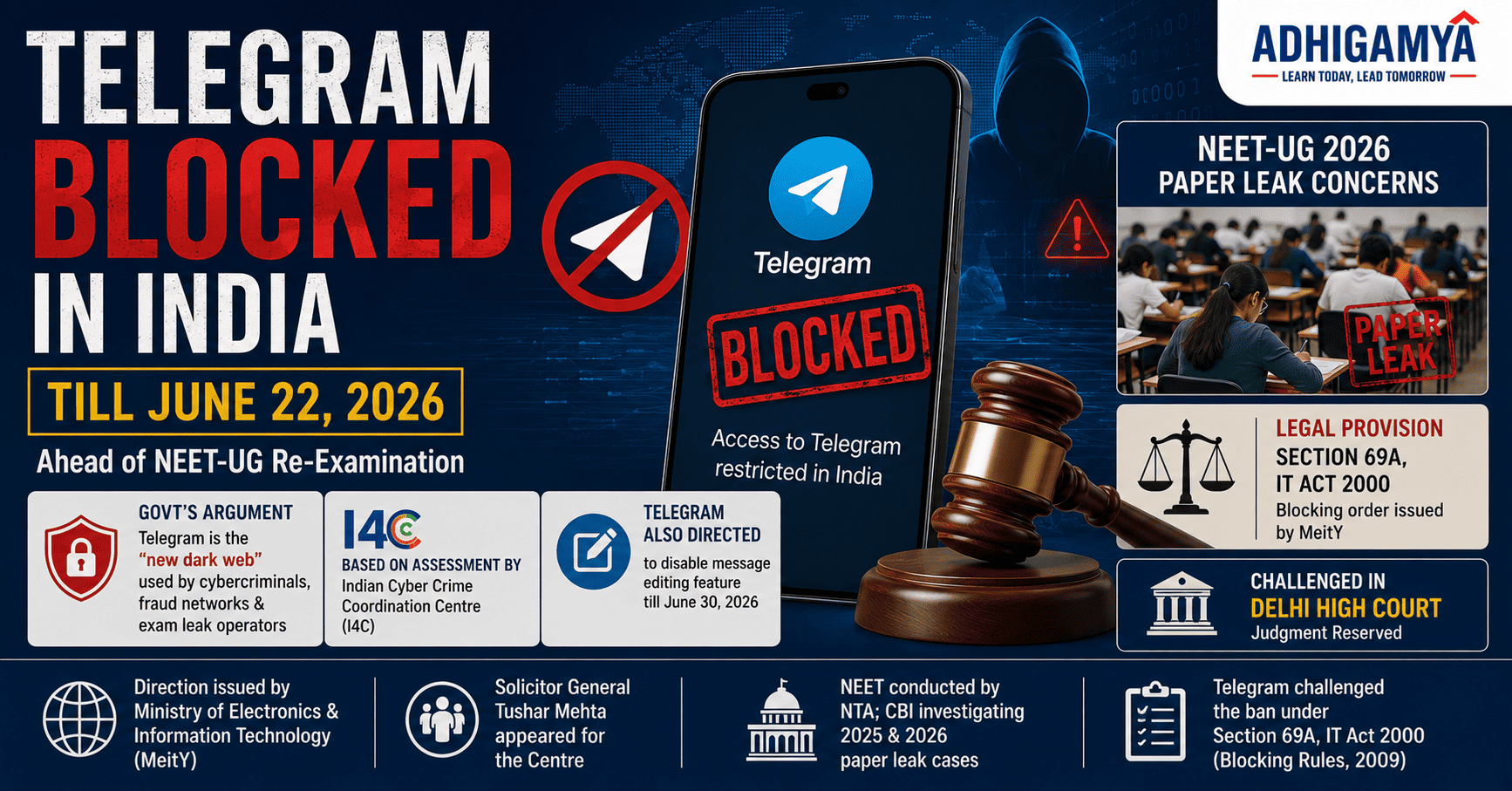
The government has restricted access to Telegram till June 22, 2026, under Section 69A of the Information Technology Act 2000, timed ahead of the NEET-UG re-examination. Telegram has challenged the ban before the Delhi High Court and judgment has been reserved. The Ministry of Electronics and Information Technology issued the blocking direction, requiring internet service providers across India to restrict user access to the platform. The government also directed Telegram to disable its message editing feature within India till June 30.
The Union government told the Delhi High Court that Telegram has evolved into the "new dark web," arguing that its architecture and privacy features have made it a preferred tool for cybercriminals, fraud networks, extremist and terror groups, and operators involved in examination paper leaks. Solicitor General Tushar Mehta, appearing for the Centre, relied heavily on an Indian Cyber Crime Coordination Centre assessment that the platform was a growing hub for illicit online activity.
The NEET-UG 2026 paper leak, which triggered the re-examination order, saw question papers circulated on Telegram channels hours before the original examination. The NTA (National Testing Agency) has been under intense scrutiny over exam integrity. CBI has filed a charge sheet in the NEET 2025 paper leak case and is currently investigating the 2026 leak.
Why in News: Government blocking of digital platforms under Section 69A and NEET paper leak cases are highly exam-relevant for SSC CGL, UPSC, Banking, and Railway exams. Key facts include Section 69A of IT Act 2000, I4C's role, the platform blocked (Telegram), the legal challenge (Delhi HC), and NTA's accountability under the NEET framework.
Key Points to Remember:
- Telegram blocked in India: till June 22, 2026
- Reason: Prevent NEET-UG paper leak during re-examination
- Legal provision used: Section 69A, Information Technology Act 2000
- Direction issued by: Ministry of Electronics and Information Technology (MeitY)
- Telegram also directed to disable message editing feature till June 30, 2026
- Government's argument: Telegram is the "new dark web"; used by cybercriminals, fraud networks, and paper leak operators
- Assessment relied on: Indian Cyber Crime Coordination Centre (I4C)
- Telegram challenged the ban in: Delhi High Court (judgment reserved)
- Solicitor General Tushar Mehta appeared for the Centre
- NEET-UG 2026 paper was circulated on Telegram before the exam
- NTA (National Testing Agency) conducts NEET-UG; has been under scrutiny for exam integrity
- CBI filed charge sheet in NEET 2025 paper leak; investigating 2026 leak as well
Related Static GK:
- Section 69A, IT Act 2000: Empowers the Union Government to block public access to any information via computer resource on six grounds — sovereignty and integrity of India, defence, security of state, friendly relations with foreign states, public order, preventing cognisable offence
- IT Act 2000: Information Technology Act; enacted in 2000; India's primary law on cybercrimes and digital governance
- I4C full form: Indian Cyber Crime Coordination Centre; under Ministry of Home Affairs; nodal body to combat cybercrime
- MeitY full form: Ministry of Electronics and Information Technology
- NTA full form: National Testing Agency; established 2017; conducts NEET-UG, JEE, CUET and other national exams
- NEET full form: National Eligibility cum Entrance Test; for MBBS and BDS admissions; conducted by NTA
- Solicitor General of India (2026): Tushar Mehta (second highest law officer; appears for Union government in courts)
- IT (Procedure and Safeguards for Blocking Access) Rules 2009: Framework under which Section 69A blocking orders are issued with review committee oversight
- Supreme Court in Shreya Singhal vs Union of India (2015): Struck down Section 66A of IT Act; upheld Section 69A as constitutional