Five New Judges Sworn In as Supreme Court Strength Rises to 37 - First Time Sanctioned Strength Raised to 38 via 2026 Ordinance to Tackle 93,000 Pending Cases
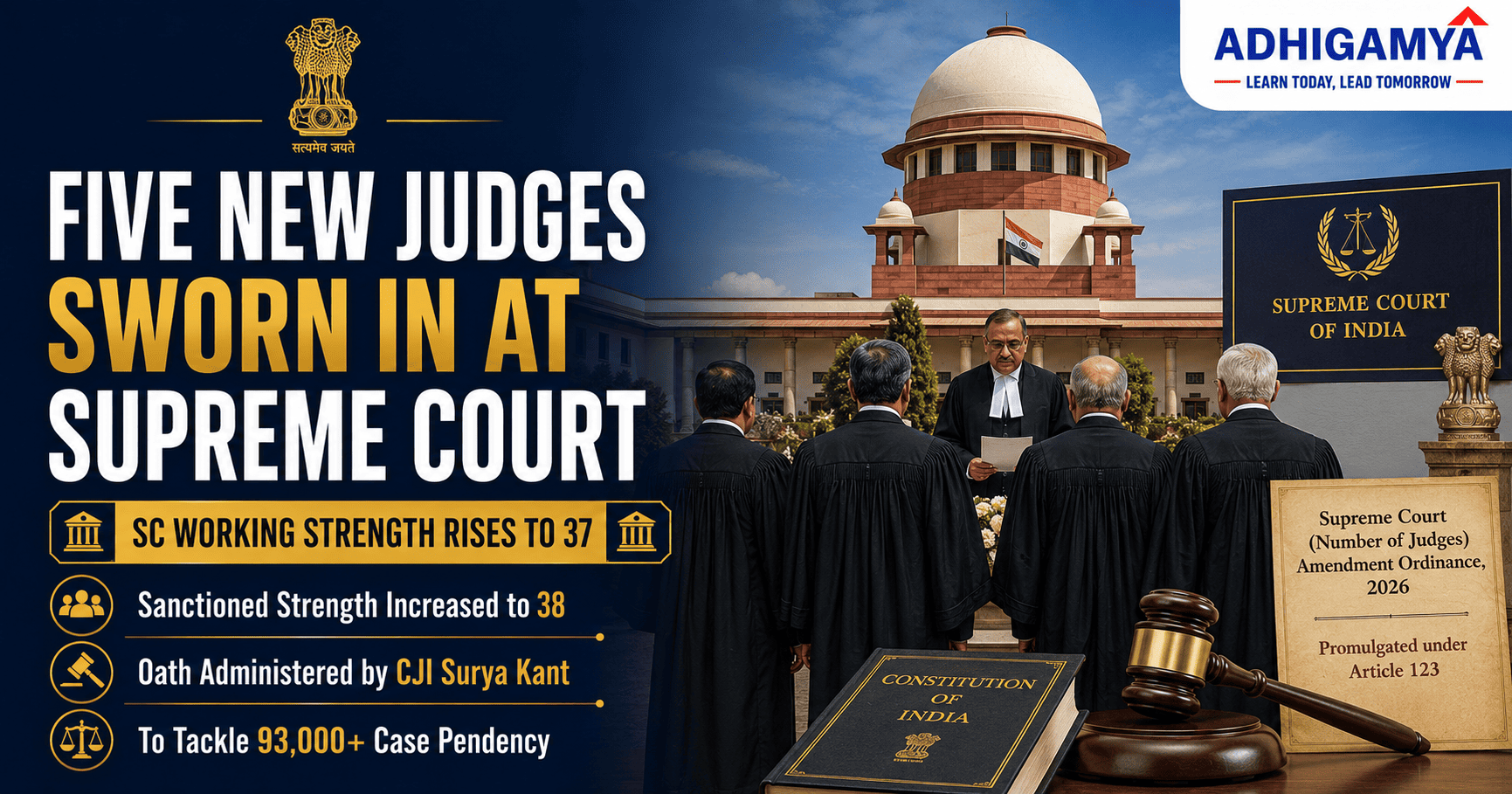
Five new judges were sworn in at the Supreme Court of India on June 2, 2026, taking its working strength to 37 judges, including the Chief Justice of India, and leaving just one vacancy against the newly expanded sanctioned strength of 38. The swearing-in ceremony was administered by Chief Justice of India Surya Kant, marking the first batch of appointments recommended by the collegium under his leadership since he assumed office as the 53rd CJI.
The five appointments followed the promulgation of the Supreme Court (Number of Judges) Amendment Ordinance, 2026, by President Droupadi Murmu on May 16, 2026, under Article 123 of the Constitution. The Ordinance amended the Supreme Court (Number of Judges) Act, 1956, raising the sanctioned strength from 34 judges to 38 - an addition of 4 judges (excluding the CJI, the number of puisne judges rose from 33 to 37). Before this expansion and the subsequent appointments, the court had been functioning with only 32 working judges against a sanctioned strength of 34, due to two pre-existing vacancies.
The Supreme Court collegium had recommended the names of four High Court Chief Justices and one additional judge on May 27, 2026. The appointments were formally notified on June 1, 2026, following presidential warrants of appointment. The expansion aims to address the mounting case pendency of over 93,000 cases in the apex court and to enable more frequent sittings of Constitution Benches.
Background: The sanctioned strength of the Supreme Court has been progressively raised over the years - from 8 judges in 1950 to 11 in 1956, 14 in 1960, 18 in 1977, 26 in 1986, 31 in 2009, and 34 in 2019. This 2026 expansion to 38 is the first increase since 2019 and the largest single increase since 1986. The Supreme Court (Number of Judges) Act, 1956 governs the strength of the court, and any amendment requires either a parliamentary Bill or a presidential ordinance. The collegium system - by which sitting SC judges recommend new appointments - has been in place since the Second Judges Case (1993) and the Third Judges Case (1998).
Why in News: This is a landmark constitutional and judicial development. For UPSC, SSC CGL, Banking, and Railway exams, questions will be asked on the new sanctioned strength (38), working strength (37), the Ordinance date, the article used (Article 123), the CJI who administered the oath (Surya Kant, 53rd CJI), the act amended (SC Number of Judges Act, 1956), and the case pendency figure (93,000+). It also tests knowledge of the collegium system, ordinance-making powers, and the constitutional provisions governing the Supreme Court.
Key Points to Remember:
- Five new Supreme Court judges sworn in on June 2, 2026
- Oath administered by: CJI Surya Kant (53rd Chief Justice of India)
- Supreme Court working strength after swearing-in: 37 (including CJI)
- One vacancy still remaining against sanctioned strength of 38
- New sanctioned strength: 38 judges (including CJI); up from 34
- Increase: 4 additional judges (puisne judges raised from 33 to 37, excluding CJI)
- Ordinance: Supreme Court (Number of Judges) Amendment Ordinance, 2026
- Ordinance promulgated by: President Droupadi Murmu on May 16, 2026
- Constitutional provision used: Article 123 (President's power to promulgate ordinances)
- Act amended: Supreme Court (Number of Judges) Act, 1956
- Collegium recommended 5 names on May 27, 2026
- Appointments notified: June 1, 2026
- Reason: To tackle case pendency of over 93,000 cases and enable more Constitution Bench sittings
- Before appointments, court was functioning with 32 judges (34 sanctioned - 2 vacancies)
- Previous expansion: 2019 (from 31 to 34); last SC strength rise before 2026
- First batch recommended by collegium under CJI Surya Kant
Related Static GK:
- Supreme Court of India established: January 28, 1950
- Supreme Court headquarters: Tilak Marg, New Delhi
- CJI (2026): Justice Surya Kant - 53rd CJI; assumed office November 24, 2025
- Article 124: Establishment and constitution of the Supreme Court
- Article 123: Power of the President to promulgate ordinances during recess of Parliament
- Supreme Court (Number of Judges) Act: 1956
- History of SC strength increases: 8 (1950) - 11 (1956) - 14 (1960) - 18 (1977) - 26 (1986) - 31 (2009) - 34 (2019) - 38 (2026)
- Collegium system origin: Second Judges Case (1993) and Third Judges Case (1998)
- Article 145: Rules of the Supreme Court (procedure and practice)
- Article 137: Power of SC to review its own judgments
- Retirement age of SC judges: 65 years; HC judges: 62 years
- An Ordinance lapses if not approved by Parliament within 6 weeks of its reassembly (Article 123(2))