Southwest Monsoon Arrives Over Kerala on June 4, 2026 - IMD Declares Onset Three Days After Normal Date; Above-Normal Rainfall Forecast for India This Season
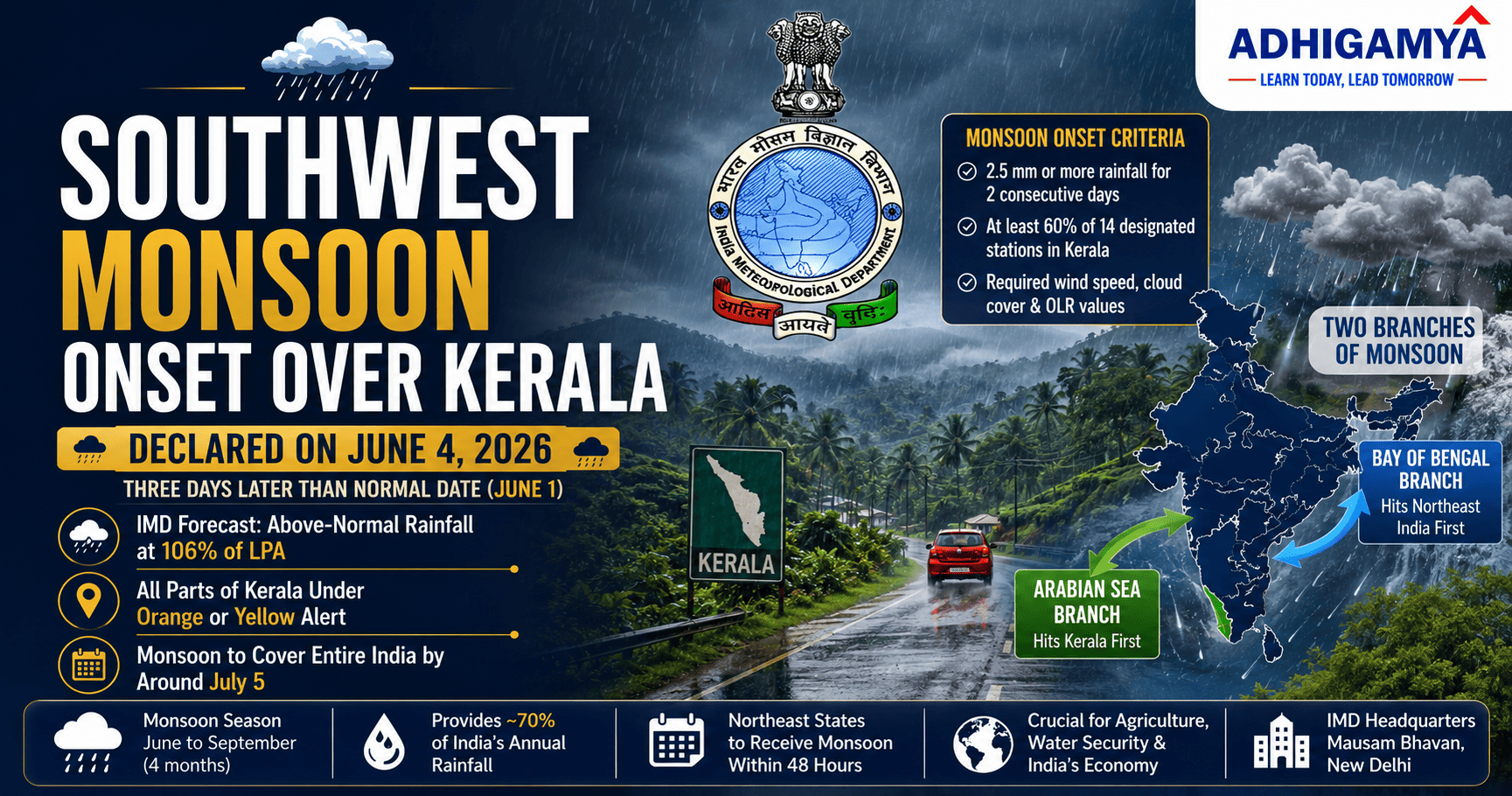
The India Meteorological Department declared the onset of the southwest monsoon over Kerala on June 4, 2026 - three days later than its normal date of June 1. IMD Scientist Neetha K Gopal confirmed that conditions for monsoon onset were ready, saying "The conditions for the onset of monsoon are getting ready, so we can declare it on 4th June. We will witness a good amount of rainfall from this evening. In the coming seven days, all parts of Kerala will be under Orange or Yellow alert as we expect a heavy spell of rain."
IMD's official press release dated June 2, 2026 had already indicated that the southwest monsoon was likely to set in over Kerala around June 4, 2026. With widespread and heavy rainfall now lashing the state, conditions across all 14 IMD monitoring stations in Kerala have met the required criteria for declaring the official monsoon onset - sustained rainfall of 2.5 mm or more over two consecutive days at 60 per cent or more of the designated stations.
IMD's long-range forecast for the 2026 southwest monsoon season projected above-normal rainfall for India overall, with rainfall expected to be 106 per cent of the Long Period Average (LPA). The monsoon is expected to advance northwards progressively, covering the entire country by around July 5, following its established track. Parts of the northeastern states are expected to receive the monsoon within 48 hours of the Kerala onset.
Background: The southwest monsoon is India's primary rainfall system, delivering nearly 70 per cent of the country's annual precipitation between June and September. It is the lifeline of India's agriculture, water reservoirs, groundwater recharge, and river systems. It originates in the Indian Ocean and the Arabian Sea, driven by the temperature differential between the Asian landmass and the surrounding oceans. The monsoon follows two branches - the Arabian Sea branch (hits Kerala first) and the Bay of Bengal branch (hits the northeastern states and gradually moves westward). IMD uses a set of criteria including sustained rainfall at 14 designated stations in Kerala, outgoing longwave radiation values, wind speed, and cloud cover to declare the official onset. The normal onset date over Kerala is June 1, and the monsoon normally covers the entire country by July 15. The 2026 monsoon season had been preceded by an active pre-monsoon rainfall pattern over Kerala and Tamil Nadu since mid-May.
Why in News: Monsoon onset is one of the most consistently asked Environment and Geography topics across SSC CGL, Banking, UPSC, and Railway examinations. The normal onset date (June 1), the monitoring criteria, the IMD's role, above/below normal classification, the LPA concept, and the two branches of the monsoon are standard exam facts. The 2026 onset on June 4 - three days late - and the above-normal forecast of 106% LPA are specific figures that will appear in current affairs questions this year.
Key Points to Remember:
- Southwest monsoon onset over Kerala declared: June 4, 2026
- Normal onset date over Kerala: June 1 (this year onset is 3 days delayed)
- IMD scientist who confirmed onset: Neetha K Gopal
- All parts of Kerala placed under Orange or Yellow alert for 7 days post-onset
- IMD 2026 long-range forecast: Above-normal rainfall at 106% of LPA (Long Period Average)
- IMD Press Release for 2026 monsoon forecast issued: June 2, 2026
- Monsoon onset criteria: 60% of 14 designated stations in Kerala must record 2.5 mm+ rainfall for 2 consecutive days, along with required wind speed, cloud cover, and OLR values
- Monsoon expected to cover entire India by: around July 5 (earlier estimate) to July 15 (upper limit)
- Northeast states to receive monsoon within 48 hours of Kerala onset
- Two branches of the monsoon: Arabian Sea branch (hits Kerala first) + Bay of Bengal branch (hits northeast)
- Southwest monsoon season duration: June to September (4 months)
- Monsoon contributes approximately 70% of India's annual rainfall
- IMD comes under: Ministry of Earth Sciences
- IMD headquarters: New Delhi (Mausam Bhavan, Lodi Road)
Related Static GK:
- IMD full form: India Meteorological Department
- IMD established: 1875; headquarters: New Delhi
- IMD comes under: Ministry of Earth Sciences (MoES)
- LPA full form: Long Period Average; the average rainfall India receives over 50 years (1971-2020 base period); LPA = 87 cm (868.6 mm) for the June-September monsoon season
- Above normal: 105-110% of LPA; Normal: 96-104% of LPA; Below normal: 90-95% of LPA; Deficient: below 90%
- Southwest monsoon covers entire India by: around July 15 (normal date)
- The monsoon retreats from northwest India around September 17 and withdraws completely by October 15
- Northeast monsoon (Winter monsoon): October-December; primarily brings rainfall to Tamil Nadu, coastal AP
- El Nino: Warming of central and eastern Pacific Ocean; generally suppresses Indian monsoon
- La Nina: Cooling of Pacific; generally enhances Indian monsoon
- IOD (Indian Ocean Dipole): Positive IOD enhances Indian monsoon; negative IOD weakens it
- 14 IMD monsoon monitoring stations in Kerala include: Thiruvananthapuram, Punalur, Kollam, Allapuzha, Kottayam, Kochi, Thrissur, Kozhikode, Thalassery, Kannur, Kudulu, Minicoy, Amini, Mangalore
- Skymet: Private weather forecasting agency in India (often declares monsoon onset before IMD)