Odisha Government Mandates Electric Vehicles for All State Government Departments from June 1, 2026
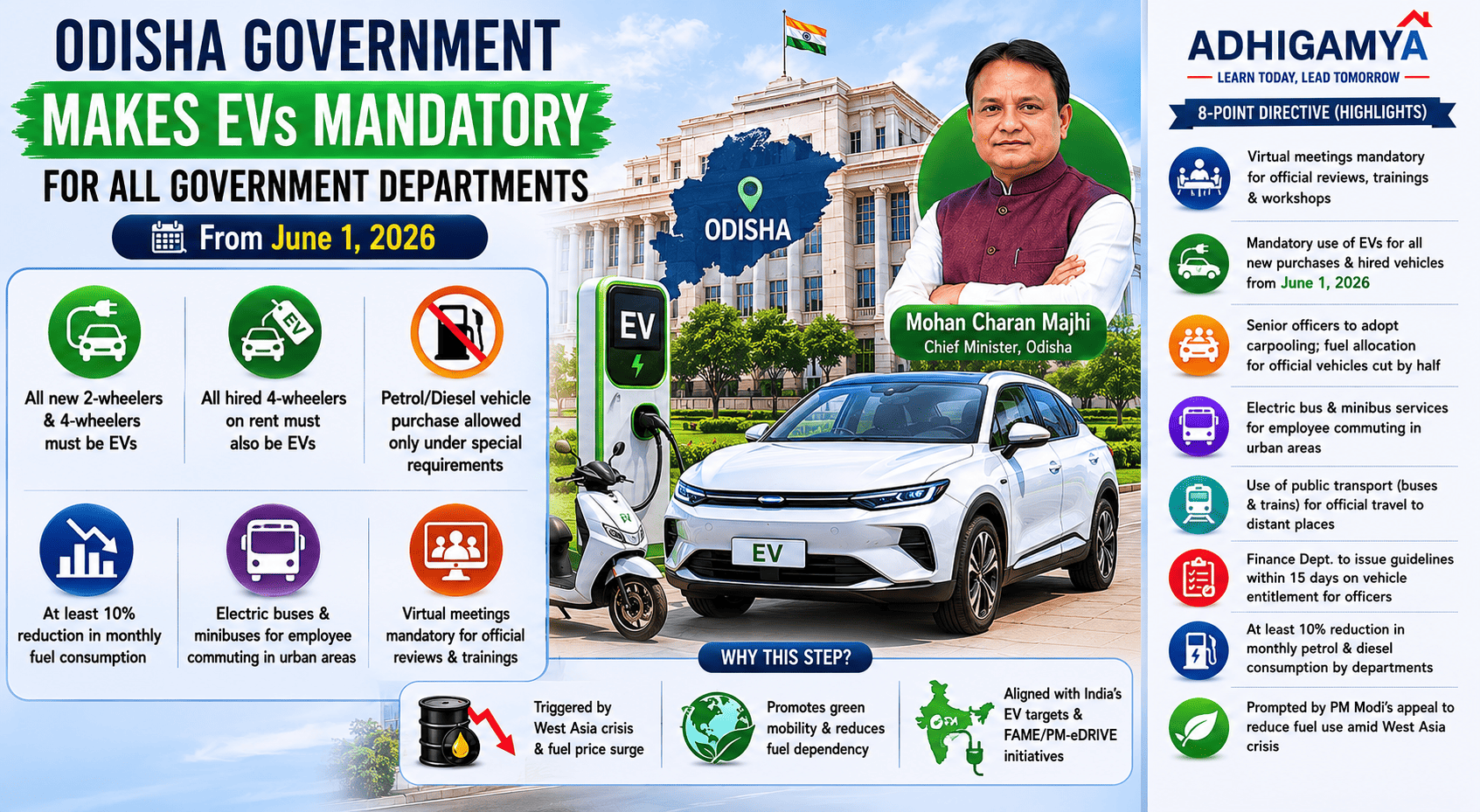
Amid the West Asia crisis and its impact on global crude oil supplies, the Odisha government has made purchasing electric vehicles (EVs) mandatory for all government departments starting June 1, 2026, as part of austerity and fuel-conservation measures. Chief Minister Mohan Charan Majhi directed that all new two-wheelers and four-wheelers purchased by government offices must be EVs from June 1. All four-wheelers hired on rent by departments must also be EVs, while purchase of petrol- and diesel-run vehicles will be allowed only under special requirements.
The Odisha government issued an eight-point directive mandating virtual official meetings wherever possible, compulsory use of electric vehicles, and a 10 per cent reduction in fuel consumption across departments. The directives were issued on the instructions of Chief Minister Mohan Charan Majhi, who had earlier reduced the size of his official convoy following Prime Minister Narendra Modi's appeal to spend wisely.
Officers and employees will use public transport like buses and trains instead of individual government vehicles when travelling to distant places for official work. To further reduce fuel consumption, electric bus and minibus services will be introduced for government employees commuting from residential clusters to offices in urban areas. The Finance Department has been asked to issue detailed guidelines within 15 days specifying which categories of senior officers will be entitled to government vehicles.
Background: India's energy security has come under pressure owing to the ongoing West Asia conflict, which has disrupted global crude oil supply chains and pushed fuel prices higher. Prime Minister Narendra Modi made a public appeal to citizens to reduce unnecessary use of petrol and diesel, prompting several state governments and institutions to adopt fuel-conservation measures. Odisha had earlier introduced an EV Policy in 2021, which aimed at 20 per cent EV adoption in total vehicle registrations by 2025. The state had also offered full exemption of motor vehicle taxes and registration fees for battery-operated vehicles under the Odisha Motor Vehicles Taxation Act to encourage faster EV adoption.
By mandating EVs for official use, Odisha becomes one of the leading states in India to formally integrate electric mobility into government operations. The move is aligned with India's broader national targets under the National Electric Mobility Mission Plan (NEMMP) and the FAME (Faster Adoption and Manufacturing of Electric Vehicles) scheme, which seek to promote EV adoption across sectors.
Why in News: Odisha's decision to mandate EVs for all government purchases and hired vehicles from June 1, 2026, is exam-relevant because it reflects an important state-level policy action on energy conservation, green mobility, and governance reform. It is directly linked to India's energy security concerns arising from the West Asia crisis, and it tests knowledge of EV policy frameworks, state government initiatives, and environmental governance. For UPSC, SSC CGL, and Banking exams, questions may be asked on FAME Scheme, India's EV targets, PM's energy conservation appeal, and Odisha's specific directives.
Key Points to Remember:
- Odisha CM Mohan Charan Majhi issued an 8-point directive to reduce fuel consumption in government offices
- Mandatory use of EVs for all new government two-wheelers and four-wheelers from June 1, 2026
- All four-wheelers hired on rent by government offices must also be EVs from June 1, 2026
- Petrol/diesel vehicle purchase allowed only under special circumstances
- Target: at least 10% reduction in monthly petrol and diesel consumption by government departments
- Virtual meetings made mandatory for official reviews, training programmes, and workshops
- Senior officers directed to adopt carpooling; fuel allocation for official vehicles cut by half
- Electric bus and minibus services to be introduced for government employee commuting
- Finance Department to issue guidelines within 15 days on vehicle entitlement for officers
- Move prompted by PM Modi's national appeal to reduce fuel use amid the West Asia crisis
- Odisha had earlier announced an EV Policy in 2021 targeting 20% EV adoption by 2025
- Chief Secretary of Odisha: Anu Garg
Related Static GK:
- Odisha capital: Bhubaneswar (administrative); Cuttack (judicial)
- Odisha Chief Minister (2026): Mohan Charan Majhi (BJP)
- Odisha Governor (2026): Hari Babu Kambhampati
- FAME Scheme full form: Faster Adoption and Manufacturing of (Hybrid &) Electric Vehicles in India - launched in 2015 by Ministry of Heavy Industries
- FAME II launched in 2019; FAME III continued to promote EV adoption with fresh incentives
- National Electric Mobility Mission Plan (NEMMP) launched in 2013
- PM-e-DRIVE Scheme: launched in September 2024 as a successor to FAME II for demand incentives
- India's EV target: 30% of private cars, 70% of commercial vehicles, 40% of buses and 80% of two- and three-wheelers to be electric by 2030 (NITI Aayog target)
- Odisha was established as a separate state on 1 April 1936; Odisha Day celebrated on 1 April (Utkala Dibasa)
- Odisha EV Policy 2021: aimed at 20% EV adoption in total vehicle registrations; provided 100% tax and registration fee exemption for battery-operated vehicles
- Ministry overseeing EV policy in India: Ministry of Heavy Industries (for FAME); Ministry of Road Transport and Highways (for vehicle standards)