Assam Introduces Uniform Civil Code Bill 2026 - Becomes First State in Northeast and Third in India to Table UCC Legislation
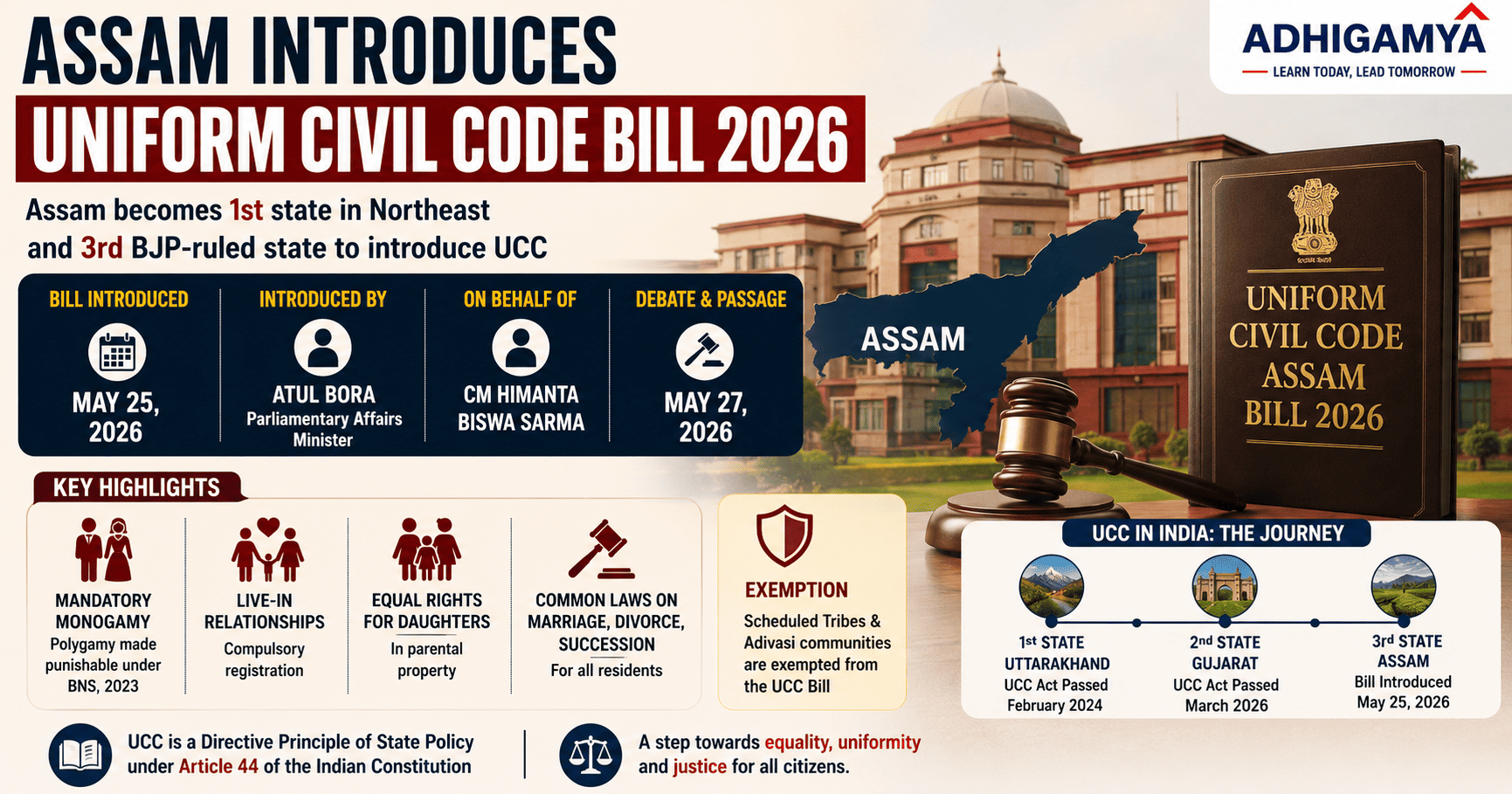
The Assam government introduced the Uniform Civil Code (UCC) Bill in the state assembly on May 25, 2026, proposing a ban on polygamy and making registration of live-in relationships compulsory. State Cabinet Minister Atul Bora introduced the Uniform Civil Code Assam Bill 2026 in the Assembly on behalf of Chief Minister Himanta Biswa Sarma. The Speaker has scheduled the bill for formal parliamentary floor debate and a final vote on May 27, 2026.
With this, Assam has become the first state in the Northeast and the third BJP-ruled state in the country to introduce such legislation. Uttarakhand was the first state to pass a Uniform Civil Code Bill in February 2024, followed by Gujarat, which cleared the legislation with a majority voice vote after a marathon debate lasting over seven hours in March 2026.
The Uniform Civil Code, Assam, 2026 Bill establishes a single civil legal framework for all residents governing marriage, divorce, succession and live-in relationships. The bill mandates monogamy for all residents under its ambit; bigamy and polygamy would attract punishment under the Bharatiya Nyaya Sanhita (BNS), 2023. The tribal population in the state will be kept outside the purview of the Uniform Civil Code Bill, as stated by Chief Minister Himanta Biswa Sarma.
Background: A Uniform Civil Code refers to a single set of laws governing personal matters such as marriage, divorce, inheritance, and adoption for all citizens of India, irrespective of their religion. Currently, personal matters of different religious communities are governed by community-specific laws - such as the Hindu Marriage Act, Muslim Personal Law, Indian Christian Marriage Act, and others. Article 44, contained in Part IV of the Constitution, says that the State shall endeavour to secure for the citizens a Uniform Civil Code throughout the territory of India. Part IV of the Constitution outlines the Directive Principles of State Policy, which while not enforceable in a court of law, are fundamental to the country's governance.
The BJP had promised to bring in the UCC in Assam in its manifesto ahead of the 2026 Assembly elections. The state Cabinet had approved the Bill in its first meeting held on May 13, 2026. Chief Minister Himanta Biswa Sarma was sworn in as Chief Minister for the second term on May 12, 2026. The minimum age of marriage, prohibition of polygamy, equal rights for daughters in parental property, and live-in relationship regulations are the four core subjects covered under the Assam UCC.
Why in News: The Assam UCC Bill 2026 is among the most significant polity and governance stories for competitive exams because it directly relates to a fundamental constitutional provision (Article 44), the ongoing national debate on personal laws, and a major state-level legislative development. For UPSC, SSC CGL, and Banking exams, questions may be asked on the Article governing UCC, the states that have enacted it, the order in which they did so, provisions of the Assam bill, tribal exemptions, and who introduced the bill. The bill is up for passage on 27 May 2026, making it a live current affair today.
Key Points to Remember:
- Assam introduced the Uniform Civil Code Bill 2026 in the state assembly on May 25, 2026
- Bill tabled by: Parliamentary Affairs Minister Atul Bora on behalf of CM Himanta Biswa Sarma
- Assam is the 1st state in Northeast India and 3rd BJP-ruled state in India to introduce UCC
- Bill scheduled for debate and passage: 27 May 2026
- 1st state to pass UCC: Uttarakhand (February 2024)
- 2nd state to pass UCC: Gujarat (March 2026)
- 4 key subjects covered: minimum marriage age, ban on polygamy, equal property rights for daughters, live-in relationship registration
- Polygamy made punishable under Bharatiya Nyaya Sanhita (BNS), 2023
- Scheduled Tribes and Adivasi communities in Assam are EXEMPTED from the UCC Bill
- UCC is a Directive Principle of State Policy under Article 44 of the Indian Constitution
- Bill introduced in 1st session of Assam Assembly under newly re-elected CM Sarma (2nd term)
- Assam CM: Himanta Biswa Sarma (BJP); sworn in for 2nd term on May 12, 2026
Related Static GK:
- Article 44 of the Indian Constitution: Directive Principle mandating UCC for all citizens
- Part IV of the Constitution: Directive Principles of State Policy (Articles 36-51)
- Directive Principles are non-justiciable but fundamental to governance
- The 21st Law Commission of India (2023) recommended against UCC at national level, calling for reforms in existing personal laws instead
- Bharatiya Nyaya Sanhita (BNS) 2023 replaced the Indian Penal Code (IPC) from July 1, 2024
- Uttarakhand UCC Act 2024: first UCC by any Indian state since independence
- The concept of UCC was recommended by the Supreme Court in the Shah Bano case (1985)
- Assam capital: Dispur; largest city: Guwahati
- Assam Governor (2026): Lakshman Prasad Acharya
- The Hindu Marriage Act (1955), Hindu Succession Act (1956), and Muslim Personal Law (Shariat) Application Act (1937) are among the major personal law statutes currently in force