IIT Bhubaneswar Develops ArsenSafe - A Portable AI-Powered Device to Detect Arsenic in Drinking Water Without Any Laboratory Infrastructure
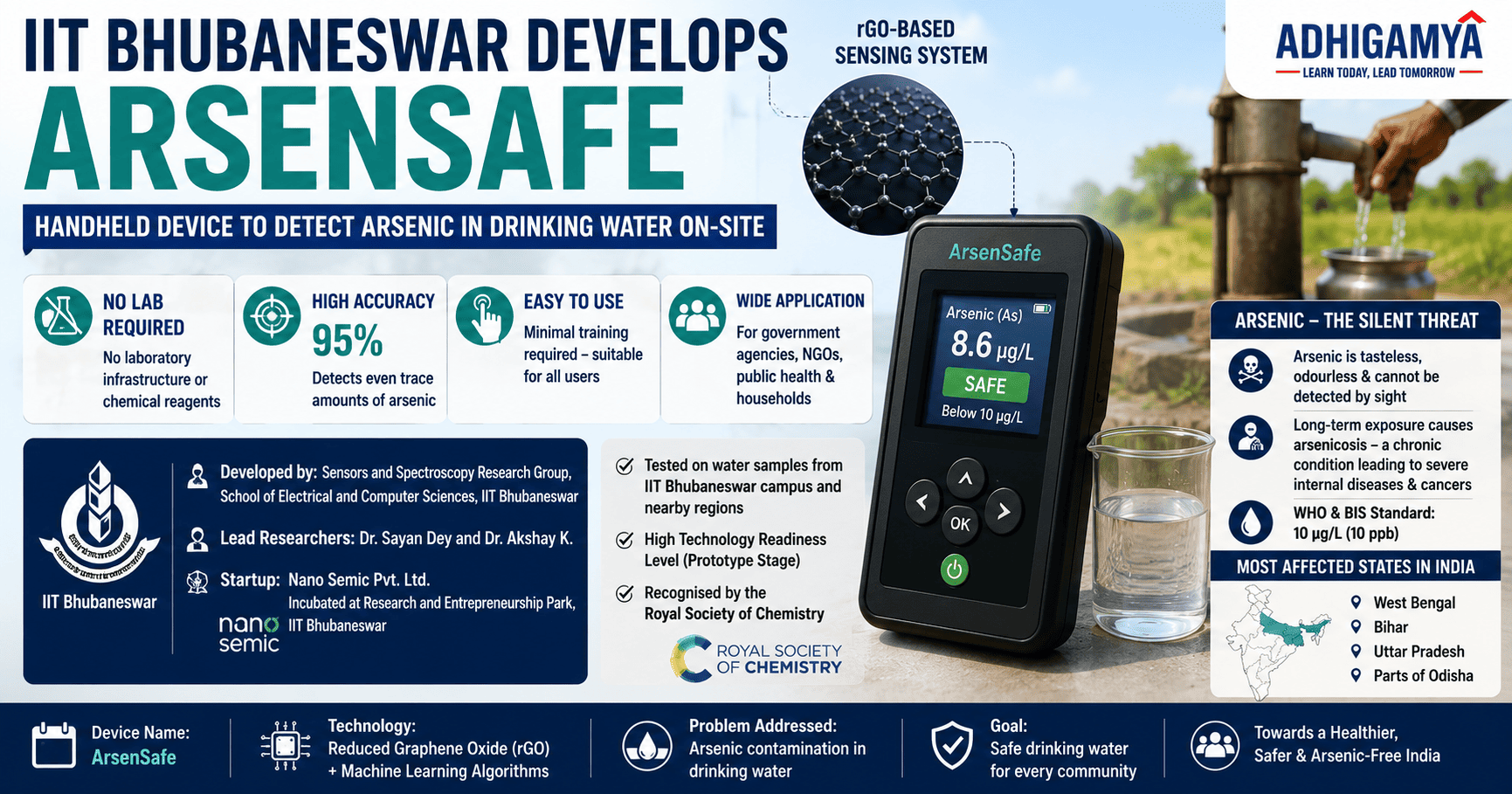
Researchers at the Indian Institute of Technology Bhubaneswar have developed a compact handheld device called ArsenSafe that can detect arsenic contamination in drinking water on-site, without needing any laboratory infrastructure or chemical reagents. The device was developed by the Sensors and Spectroscopy Research Group of the School of Electrical and Computer Sciences, led by Dr. Sayan Dey and Dr. Akshay K., through their startup Nano Semic Pvt. Ltd., which is incubated at the Research and Entrepreneurship Park of IIT Bhubaneswar.
ArsenSafe works on a reduced graphene oxide (rGO)-based sensing system combined with machine learning algorithms, giving it 95 percent accuracy in detecting even trace amounts of arsenic. It requires minimal training to operate, making it accessible to government agencies, public health departments, NGOs, and even individual households in remote and rural areas. The prototype has already been tested on water samples from the IIT Bhubaneswar campus and nearby regions and has attained a high Technology Readiness Level. The technology has also received recognition from the Royal Society of Chemistry.
Arsenic is a tasteless, odourless, and highly toxic metalloid that seeps into groundwater naturally through soil and rock. Long-term exposure causes arsenicosis - a chronic condition leading to severe internal diseases and potentially fatal cancers. The Central Ground Water Board has flagged excess arsenic in several districts of India, particularly in West Bengal, Bihar, Uttar Pradesh, and parts of Odisha.
Why in News: Innovation in water safety technology from Indian academic institutions is an increasingly common exam topic. Key facts include the device name (ArsenSafe), institution (IIT Bhubaneswar), technology used (rGO-based sensing plus machine learning), startup name (Nano Semic Pvt. Ltd.), accuracy (95%), recognition received (Royal Society of Chemistry), and the public health problem it addresses (arsenic contamination).
Key Points to Remember:
- Device name: ArsenSafe
- Developed by: IIT Bhubaneswar (Sensors and Spectroscopy Research Group, School of Electrical and Computer Sciences)
- Lead researchers: Dr. Sayan Dey and Dr. Akshay K.
- Startup: Nano Semic Pvt. Ltd. — incubated at Research and Entrepreneurship Park, IIT Bhubaneswar
- Technology: Reduced graphene oxide (rGO)-based sensing system + machine learning algorithms
- Accuracy: 95 percent
- No laboratory infrastructure or chemical reagents needed
- Can be operated with minimal training
- Tested on water samples from IIT Bhubaneswar campus and nearby areas
- Technology Readiness Level: High (prototype stage completed)
- Recognition: Royal Society of Chemistry
- Arsenic causes: arsenicosis — chronic condition with severe internal diseases and fatal cancers
- Arsenic is tasteless, odourless, and cannot be detected by sight
- Most affected Indian states: West Bengal, Bihar, UP, parts of Odisha
Related Static GK:
- IIT Bhubaneswar: Located in Bhubaneswar, Odisha; established 2008; one of the new-generation IITs
- Reduced Graphene Oxide (rGO): A form of graphene used in sensor technology; derived from graphene oxide through chemical or thermal reduction
- Graphene: Single layer of carbon atoms; one of the strongest and most conductive materials known
- Royal Society of Chemistry: UK-based learned society and professional body for chemical sciences; founded 1841; HQ: London
- WHO guideline for arsenic in drinking water: 10 micrograms per litre (10 ppb)
- BIS standard for arsenic in drinking water in India: 10 micrograms per litre
- Jal Jeevan Mission: India's flagship programme to provide tap water to every rural household by 2024 (extended); arsenic-free water is a key objective
- Central Ground Water Board (CGWB): Under Ministry of Jal Shakti; monitors groundwater quality including arsenic levels