FCRA Amendment Bill 2026 Introduced in Lok Sabha to Regulate Foreign Funding of NGOs and Strengthen Asset Control Under a New Designated Authority
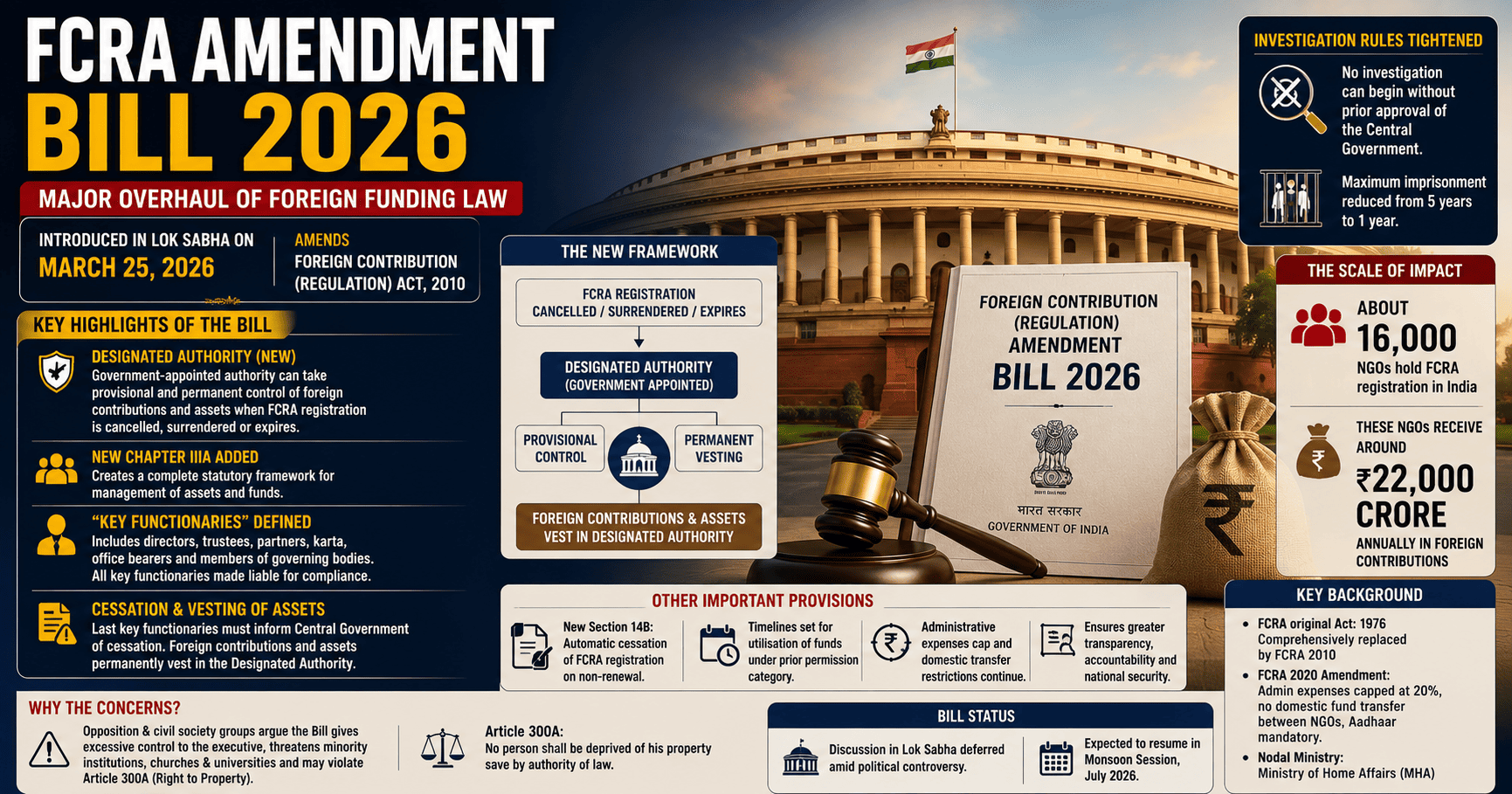
The Government of India introduced the Foreign Contribution (Regulation) Amendment Bill 2026 in the Lok Sabha on March 25, 2026, proposing major structural changes to the Foreign Contribution (Regulation) Act 2010, which governs acceptance and use of foreign funds by NGOs and associations in India. The most significant change in the 2026 amendment is the creation of a government-appointed Designated Authority that can take provisional and permanent control of foreign contributions and assets of organisations in cases where their FCRA registration is cancelled, surrendered, or expires.
The bill introduces a brand-new Chapter IIIA creating a full statutory framework for asset management. The bill also introduces the term "key functionaries" defined to include directors, partners, trustees, karta, office bearers, and members of governing bodies, making every leadership position liable for compliance. A significant new obligation requires the last key functionaries of a defunct organisation to inform the Central Government of its cessation status, after which foreign contributions and assets permanently vest in the Designated Authority.
The bill reduces maximum imprisonment under FCRA from 5 years to 1 year but mandates that no investigation can begin without prior approval of the Central Government. The FCRA regime has seen progressive tightening over the years. Approximately 16,000 associations hold FCRA registration in India and collectively receive around Rs 22,000 crore annually in foreign contributions. Discussion on the bill was subsequently deferred in Lok Sabha amid political controversy and is expected to resume in the Monsoon Session scheduled for July 2026.
Background: The Foreign Contribution (Regulation) Act was originally enacted in 1976 and comprehensively replaced by FCRA 2010. The 2020 amendment had already imposed stricter conditions including capping administrative expenses at 20 per cent and restricting domestic fund transfers between NGOs. The 2026 amendment continues this trajectory of tightening. The government's stated position is that the changes are needed to prevent misuse and diversion of foreign funds against national interest. Opposition parties and civil society groups have raised strong concerns that the bill gives the executive excessive control over NGO property, threatens minority institutions, churches, and universities, and potentially violates Article 300A of the Constitution which protects the right to property.
Why in News: The FCRA Amendment Bill 2026 is highly exam-relevant for UPSC, SSC CGL, Banking, and Railway examinations because it involves significant changes to a law governing foreign funding, NGO regulation, and constitutional rights. Questions can be asked on the bill name, the act being amended (FCRA 2010), the Designated Authority concept, the new Chapter IIIA, prior approval for investigation, reduction in imprisonment from 5 years to 1 year, Article 300A concerns, the scale of impact (16,000 NGOs and Rs 22,000 crore annual foreign funding), and the nodal ministry (Ministry of Home Affairs).
Key Points to Remember:
- FCRA Amendment Bill 2026 introduced in Lok Sabha on March 25, 2026
- Bill amends the Foreign Contribution (Regulation) Act 2010
- Most important change: New Designated Authority created under Chapter IIIA to control foreign-funded assets when FCRA registration is cancelled, surrendered, or expires
- Assets provisionally and permanently vest in Designated Authority on registration failure
- New term "key functionaries" introduced covering directors, trustees, partners, office bearers
- All key functionaries held personally liable for compliance failures
- Prior approval of Central Government mandatory before any FCRA investigation begins
- Maximum imprisonment reduced from 5 years to 1 year
- New Section 14B: automatic cessation of FCRA registration on non-renewal
- Timelines set for fund utilisation under prior permission category
- About 16,000 NGOs hold FCRA registration in India
- These NGOs collectively receive approximately Rs 22,000 crore annually
- Opposition concern: Violates Article 300A (Right to Property) without adequate safeguards
- Bill discussion deferred in Lok Sabha; expected to resume in Monsoon Session (July 2026)
- Bill status as of June 2026: Pending (neither passed nor withdrawn)
- FCRA 2020 amendment had capped administrative expenses at 20 per cent and restricted domestic fund transfers
- Nodal ministry: Ministry of Home Affairs (MHA)
Related Static GK:
- FCRA full form: Foreign Contribution (Regulation) Act
- FCRA original act: 1976; replaced comprehensively by FCRA 2010
- FCRA 2010 governs: Acceptance and use of foreign funds by individuals, NGOs, and associations in India to protect national interest
- FCRA 2020 amendment key changes: Administrative expenses capped at 20 per cent; no domestic fund transfer allowed between NGOs; Aadhaar mandatory for registration
- FCRA registration validity: 5 years; must be renewed periodically
- Article 300A: "No person shall be deprived of his property save by authority of law" (Right to Property under the Constitution but not a Fundamental Right)
- Right to Property history: Was a Fundamental Right until the 44th Constitutional Amendment Act 1978; now placed in Article 300A under Part XII
- Article 19(1)(c): Fundamental Right to form associations or unions (Part III)
- Ministry of Home Affairs: Nodal authority for FCRA implementation and enforcement
- Lok Sabha Speaker (2026): Om Birla
- Budget Session of Parliament 2026: January 28 to April 2, 2026
- Monsoon Session of Parliament 2026: Scheduled for July 2026