Election Commission Directs Special Intensive Revision (SIR) of Electoral Rolls to Begin June 2026 - Chief Electoral Officers of 22 States and UTs to Complete Preparatory Work
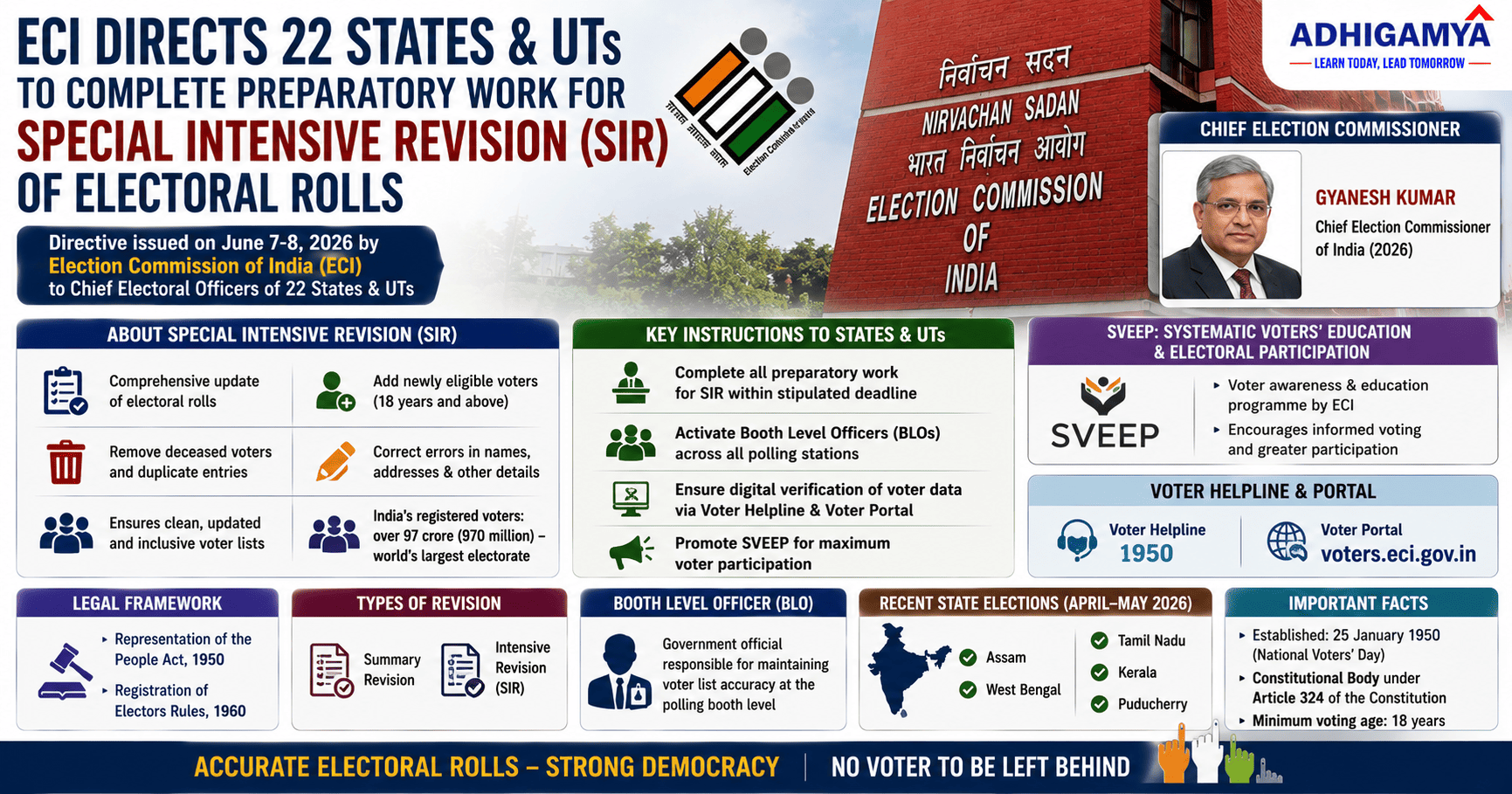
The Election Commission of India (ECI) has directed the Chief Electoral Officers of 22 states and Union Territories to complete all preparatory work for the Special Intensive Revision (SIR) of electoral rolls, as part of its drive to ensure clean, updated, and inclusive voter lists ahead of the next cycle of state and national elections. The directive was issued on June 7-8, 2026, as part of the ECI's systematic voter registration and de-duplication exercise.
The Special Intensive Revision is a periodic exercise conducted by the Election Commission of India to update electoral rolls comprehensively - adding newly eligible voters (those who turn 18), removing deceased voters and duplicate entries, and correcting errors in names and addresses. The SIR exercise is especially important in states that are due to hold assembly elections in the near future. The directive to 22 states and UTs covers states across all major regions of India to ensure that the voter lists reflect the most current population data.
The ECI, under Chief Election Commissioner Gyanesh Kumar, has been emphasising the concept of "SVEEP" - Systematic Voters' Education and Electoral Participation - alongside the SIR process. All Chief Electoral Officers have been asked to ensure that the SIR exercise is completed within the stipulated deadline, Booth Level Officers (BLOs) are activated across all polling stations, and digital verification of voter data is completed through the Voter Helpline (1950) and the Voter Portal.
Background: The Electoral Roll is the list of all registered voters in a constituency. Maintaining an accurate electoral roll is fundamental to free and fair elections. The Representation of the People Act, 1950 and the Registration of Electors Rules, 1960 govern the preparation and revision of electoral rolls. There are two types of electoral roll revisions: Summary Revision (brief, targeted updates) and Intensive Revision (comprehensive updates conducted house-to-house). The SIR is the most thorough form of revision, with Booth Level Officers visiting every household in their assigned polling booth area to verify and update voter data.
India currently has over 97 crore (970 million) registered voters - the largest electorate in the world. The ECI conducts SIR exercises periodically to keep this list current. Recent state assembly elections in Assam, West Bengal, Tamil Nadu, Kerala, and Puducherry (held in April-May 2026) underline the importance of keeping electoral rolls accurate and up-to-date for upcoming elections.
Why in News: The ECI's SIR directive is exam-relevant for UPSC, SSC CGL, Banking, and Railway examinations because electoral roll revision is a fundamental constitutional process. Questions may be asked on the SIR full form, the act governing electoral rolls (Representation of the People Act, 1950), the role of Booth Level Officers, SVEEP, the Chief Election Commissioner (Gyanesh Kumar), the Voter Helpline number (1950), and India's total registered voters (97+ crore). This directive also reflects ongoing preparations for the next cycle of assembly elections across states.
Key Points to Remember:
- ECI directed 22 states/UTs to complete SIR preparatory work: June 7-8, 2026
- SIR full form: Special Intensive Revision (of Electoral Rolls)
- Purpose: Update electoral rolls - add new eligible voters (18+), remove deceased, correct errors
- Directed by: Election Commission of India (ECI)
- Chief Election Commissioner (2026): Gyanesh Kumar
- 22 states and UTs directed to complete preparatory work
- Key personnel for SIR: Booth Level Officers (BLOs) - deployed at every polling station
- SVEEP: Systematic Voters' Education and Electoral Participation - ECI voter awareness programme
- Voter Helpline: 1950 (national voter helpline number)
- Voter Portal: voters.eci.gov.in
- India's registered voters: over 97 crore (970 million) - world's largest electorate
- Electoral roll governed by: Representation of the People Act, 1950 + Registration of Electors Rules, 1960
- Types of revision: Summary Revision + Intensive Revision (SIR is intensive)
- Recent state elections completed: Assam, West Bengal, Tamil Nadu, Kerala, Puducherry (April-May 2026)
Related Static GK:
- ECI full form: Election Commission of India
- ECI established: 25 January 1950 (celebrated as National Voters' Day every year)
- ECI is a constitutional body under Article 324 of the Indian Constitution
- Article 324: Superintendence, direction, and control of elections vested in the Election Commission
- Chief Election Commissioner (CEC): Gyanesh Kumar (current); CEC has security of tenure like a Supreme Court judge
- Model Code of Conduct (MCC): Comes into force from the date of election schedule announcement
- Representation of the People Act, 1950: Governs preparation of electoral rolls
- Representation of the People Act, 1951: Governs actual conduct of elections
- Booth Level Officer (BLO): Government official responsible for maintaining voter list accuracy at the polling booth level
- SVEEP full form: Systematic Voters' Education and Electoral Participation; ECI's flagship voter awareness programme
- National Voters' Day: January 25 (ECI's founding anniversary)
- Minimum voting age in India: 18 years (reduced from 21 by the 61st Constitutional Amendment Act, 1988)
- India's electorate: Over 97 crore registered voters (world's largest democracy)
- ECI headquarters: Nirvachan Sadan, Ashoka Road, New Delhi